AI estimate as of December 2, 2025 · verify with a professional before acting
AI-Generated · Verify before acting
Everything on this page is generated by AI for informational purposes only. AI can make mistakes — the AI may misidentify items or misattribute them (artist, maker, brand, designer, origin, era). This is not an official valuation and should not be used for insurance, sale, tax, estate, legal, or lending purposes — or any decision requiring a certified appraisal. It is not an authoritative claim about any person, brand, or rights holder — do not share or rely on it as a factual statement about a third party. Always consult qualified professionals before making financial decisions.
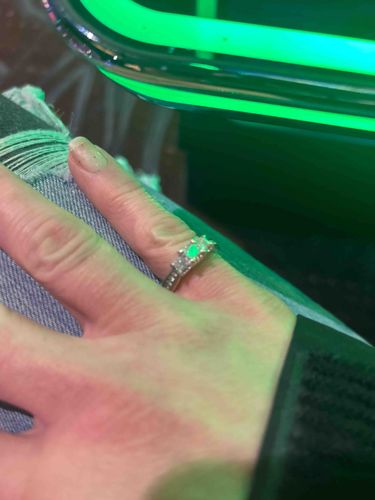
The item is a finger ring, likely crafted from white gold, platinum, or sterling silver, given its silvery-white metallic sheen. The design features a prominent three-stone setting, often referred to as a 'trilogy' or 'past, present, future' style. The central gemstone appears to be a square or princess cut, while the two flanking stones are also square or princess cut, but slightly smaller than the center. All three main stones exhibit significant sparkle, suggesting they are either diamonds or high-quality cubic zirconia. The surrounding stones in the halo and along the band are smaller, round brilliant-cut accents, set into the metal, likely in a pave or channel setting, extending down the shoulders of the band. The metal band itself appears to be of moderate thickness. The ring is worn on the ring finger of a person with fair skin, and the hand is resting against a blue denim fabric, possibly jeans. The overall lighting is heavily influenced by a strong green light source, which causes a green luminescence or reflection on the gemstones, making it difficult to ascertain their true color without this external light interference. There are no clear visible markings or engravings, and no overt signs of damage or wear are discernible from the image, aside from a slight natural patina or dullness that might be present on the metal, typical of worn jewelry. The craftsmanship appears to be of good quality, with stones well-set and a classic, elegant design. The estimated age depends on the materials; if diamonds, it could be a contemporary engagement or anniversary ring; if cubic zirconia, it might be a fashion ring, likely from the late 20th or early 21st century.
AI Appraisal Report
Upon visual examination of the provided image, I observe a 'trilogy' style finger ring featuring a prominent square or princess cut center stone flanked by two slightly smaller square or princess cut stones. The design includes surrounding smaller, round brilliant-cut accent stones, set in a pave or channel style along the shoulders of the band, which appears to be of a silvery-white metal. The craftsmanship appears to be good, with stones well-set and a classic design, suggesting an overall good condition. There are no overt signs of damage or wear, aside from a possible natural patina. The strong green lighting significantly impacts my ability to ascertain the true color and clarity of the gemstones, as it casts a green luminescence. The most critical factor impacting value is the identity of the stones: whether they are diamonds or high-quality cubic zirconia (CZ). If the main stones are diamonds, particularly if they are natural and of good quality (even commercial grades), and the metal is platinum or white gold, the value would be significantly higher. If they are CZ and the metal is sterling silver, it would fall into a much lower fashion jewelry category. Currently, without definitive identification of the stones, assuming the higher end for potential diamonds and lower for CZ, market comparables for similar designs range widely. Rings with natural diamonds of this size and setting in precious metals could easily fetch $1,500 or more, whereas a well-made CZ/silver ring might be $500 or less. Demand for trilogy rings remains consistent. Rarity is not a significant factor here; this is a popular and common design.
Limitations: Visual examination from an image alone prevents definitive authentication of the gemstones or metal. To accurately determine authenticity, an in-person examination is crucial. This would involve specific gravity and refractive index tests for the gemstones to distinguish between diamond and CZ, and metal testing (e.g., acid testing or XRF analysis) to confirm gold, platinum, or silver content. Additionally, examining for hallmarks or engravings, which are not visible here, would provide further clues regarding provenance and material composition. Without these, the value provided is an informed estimate based on potential materials.