AI estimate as of June 27, 2025 · verify with a professional before acting
AI-Generated · Verify before acting
Everything on this page is generated by AI for informational purposes only. AI can make mistakes — the AI may misidentify items or misattribute them (artist, maker, brand, designer, origin, era). This is not an official valuation and should not be used for insurance, sale, tax, estate, legal, or lending purposes — or any decision requiring a certified appraisal. It is not an authoritative claim about any person, brand, or rights holder — do not share or rely on it as a factual statement about a third party. Always consult qualified professionals before making financial decisions.
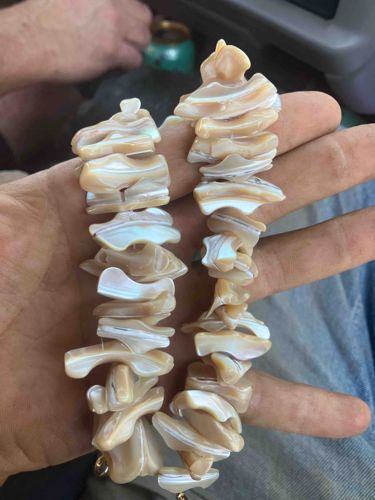
The item is a natural shell chip strand, likely intended for use as a necklace, bracelet, or for crafting purposes. It consists of numerous irregular, flat, and somewhat curved pieces of shell, strung together. The shells exhibit a beautiful natural coloration, primarily in shades of creamy beige, tan, and light brown, with prominent pearlescent white and iridescent blue-green flashes on one side of most chips. This iridescence suggests they are from a nacreous shell, possibly mother-of-pearl or abalone. Each shell chip varies in size and shape, ranging from narrow, elongated shards to broader, flatter pieces, with organic, unfinished edges characteristic of natural shell. The chips appear to be drilled through, allowing them to be strung linearly. The stringing material is not clearly visible within the chips but appears to be a fine thread or wire. At the very bottom of the visible strand (at least one of the two strands shown), there is a small, unidentifiable gold-toned metal loop, which could be part of a clasp or a connection point for jewelry making. The condition appears to be good; the shells show their natural variations and textures. There are no obvious signs of significant damage, such as large cracks or chips beyond their natural formation, nor any visible repairs. The overall impression is one of natural beauty and an earthy aesthetic, consistent with handmade or natural material jewelry, likely from the late 20th or early 21st century given the style of shell chip jewelry's popularity.
AI Appraisal Report
I have examined the provided image of what appears to be a natural shell chip strand. Based on this visual inspection, the condition of the shell chips appears good, exhibiting natural variations in size, shape, and coloration, including prominent pearlescent and iridescent flashes indicative of nacreous shell, likely mother-of-pearl or abalone. There are no obvious signs of significant damage or repair. The authenticity as natural shell chips is highly probable given the irregular forms and natural luster; machine-made or artificial chips would typically show greater uniformity. The small gold-toned loop suggests its intended use in jewelry crafting.
Market conditions for natural shell chip strands are generally modest. These items are common in the craft and hobby markets, often used by jewelry makers. Comparable items, such as similar chip strands or pre-made necklaces using similar materials, typically retail for modest sums. Demand is relatively steady within the artisan and crafting communities, but these materials are not considered rare.
The primary factors impacting value are the material (natural shell), the labor involved in drilling and stringing, and the aesthetic appeal. The lack of precious metals or gemstones limits its intrinsic material value. Given its likely purpose as a component for further crafting rather than a finished piece of high-end jewelry, its value remains in line with raw materials for artisans.
It is imperative to note that my authenticity verification is limited to visual examination of the image. For full authentication, an in-person examination would allow for tactile inspection of the shell's texture, a more definitive identification of the shell type (e.g., specific abalone species vs. mother-of-pearl), and assessment of the drilling quality. Provenance documentation, though unlikely for such an item, could verify origin. Scientific testing, such as spectroscopy, is unnecessary and not cost-effective for an item of this nature.