AI estimate as of July 14, 2025 · verify with a professional before acting
AI-Generated · Verify before acting
Everything on this page is generated by AI for informational purposes only. AI can make mistakes — the AI may misidentify items or misattribute them (artist, maker, brand, designer, origin, era). This is not an official valuation and should not be used for insurance, sale, tax, estate, legal, or lending purposes — or any decision requiring a certified appraisal. It is not an authoritative claim about any person, brand, or rights holder — do not share or rely on it as a factual statement about a third party. Always consult qualified professionals before making financial decisions.
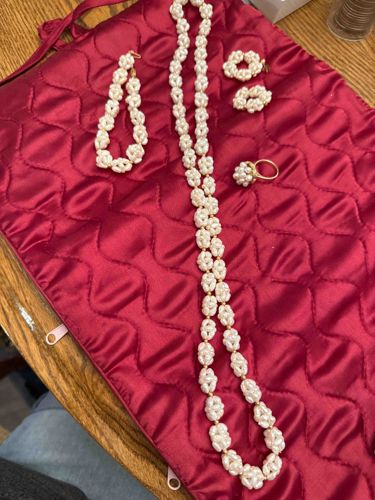
This appears to be a vintage four-piece jewelry set crafted from numerous small, off-white to cream-colored imitation pearls, possibly glass or plastic, arranged in cluster formations. The set includes a long necklace, a matching bracelet, a ring, and a pair of clip-on earrings. Each piece showcases a distinctive design where multiple small, round pearls are intricately clustered together, often resembling small floral or 'popcorn' shapes, connected by what appear to be small gold-toned beads or spacers. The construction method seems to involve stringing, with visible gold-toned elements suggesting either gold-plated metal or brass findings. The necklace is long, appearing to be strand-style, composed of these pearl clusters. The bracelet features the same cluster design. The ring has a prominent pearl cluster as its centerpiece, mounted on a thin, gold-toned band. The earrings are clip-on, each featuring a single pearl cluster. The overall condition appears good for a vintage set, with no immediately visible significant damage, chipping, or discoloration to the pearls from the image provided. There might be some minor wear consistent with age and use, such as slight tarnishing on the metal components or minor abrasions on the pearl surfaces, but this cannot be confirmed without closer inspection. The absence of maker's marks or signatures is common for costume jewelry of certain periods. Given the style and materials, it likely dates from the mid-20th century, possibly the 1950s or 1960s, reflecting the popular 'cluster' or 'grape' motif often seen in fashion jewelry of that era. The craftsmanship, while not fine jewelry grade, exhibits a consistent and neat assembly of the pearl clusters, indicating standard manufacturing practices for costume pieces of its time.
AI Appraisal Report
I've examined the provided image of this Vintage Faux Pearl Cluster Jewelry Set. Based on visual assessment, the set, comprising a necklace, bracelet, ring, and clip-on earrings, appears to be in good vintage condition. The individual faux pearls, likely glass or plastic, show no obvious major damage, chipping, or discoloration. The cluster formations are consistent throughout, suggesting a uniform manufacturing process common in costume jewelry. The gold-toned findings, while not definitively gold, are typical for pieces of this era. Authenticity, based solely on imagery, points to a mid-20th-century costume jewelry set, likely 1950s-1960s, given the popular 'cluster' or 'grape' motif. The absence of maker's marks is not uncommon for this type of item.
Market conditions for vintage costume jewelry, particularly "grape" or "popcorn" style faux pearl sets, show moderate demand. While not rare, a complete matching set in good condition adds to its appeal. Comparables in the online vintage market typically range from $75 to $150 for similar multi-piece sets, depending on condition and perceived quality. The primary factors impacting value here are completeness, overall condition, and the aesthetic appeal of the cluster design. Without physical inspection, I cannot confirm minor wear, tarnish on metal, or abrasions to the pearls. A tactile examination would be needed to assess the material of the 'pearls' (glass vs. plastic), the metal composition, and the integrity of the stringing or adhesive. Provenance documentation would further enhance authentication but is rarely available for such items.