AI estimate as of July 12, 2025 · verify with a professional before acting
AI-Generated · Verify before acting
Everything on this page is generated by AI for informational purposes only. AI can make mistakes — the AI may misidentify items or misattribute them (artist, maker, brand, designer, origin, era). This is not an official valuation and should not be used for insurance, sale, tax, estate, legal, or lending purposes — or any decision requiring a certified appraisal. It is not an authoritative claim about any person, brand, or rights holder — do not share or rely on it as a factual statement about a third party. Always consult qualified professionals before making financial decisions.
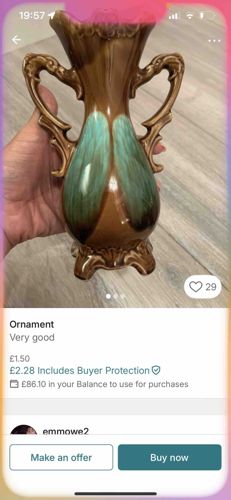
The item is a small, handled ceramic vase, likely intended as a decorative ornament. It features a bulbous body transitioning to a narrower neck, flaring slightly at the rim. Two scrolled handles, possibly inspired by classical or Baroque designs, symmetrically extend from the mid-section up to just below the rim. The primary color scheme consists of a glossy brown glaze, accented by two prominent, vertical teardrop or flame-like patterns in a vibrant turquoise or teal color on the front and back of the body. The brown glaze appears somewhat translucent, allowing for subtle variations in tone. Further decorative elements include a scalloped or shell-like motif encircling the rim and a similarly detailed, ornate base with four small, decorative feet. The overall construction suggests molded ceramic, likely mass-produced. There are no obvious signs of significant damage, cracks, or chips visible in the image, and the glaze appears to be intact, indicating a "very good" condition as described in the accompanying text. The shiny finish suggests it has been well-preserved or is relatively new. No specific maker's marks or signatures are discernable from the provided image. The style hints at mid-20th century aesthetics, possibly from the 1950s to 1970s, often seen in domestic decorative items.
AI Appraisal Report
Upon examining the provided image of this two-handled ceramic vase/ornament, I assess its condition as very good. The glossy brown glaze, accented by the vibrant turquoise teardrop patterns, appears intact with no visible cracks, chips, or significant wear. The scrolled handles, scalloped rim, and ornate base with four feet are all present and undamaged. The overall finish suggests good preservation.
Authenticity, based solely on visual inspection, points to a mass-produced decorative item, likely from the mid-20th century (1950s-1970s). The style aligns with common domestic decorative items of that period. Without maker's marks or provenance, definitive authentication to a specific manufacturer or artist is impossible. My assessment of authenticity is limited by the lack of physical examination; an in-person inspection would allow me to check for hidden marks, assess the ceramic body's quality more thoroughly, and gauge its weight and tactile feel. Provenance documentation, such as original purchase receipts or family history, would also be invaluable.
Factors impacting value: This is a decorative piece, not a functional antique of high craftsmanship. Its value is driven by its aesthetic appeal, condition, and collectibility as a vintage item. There's moderate demand for well-preserved mid-century decorative ceramics, especially those with interesting glazes or forms. However, similar mass-produced items are not particularly rare. Market comparables for such pieces typically range from modest to low-tier collector prices, as they are widely available.
To fully authenticate and understand its market position, I would need to physically inspect the piece for any hidden marks, quality of ceramic body, and manufacturing techniques. Scientific testing (e.g., thermoluminescence dating) is typically not cost-effective or necessary for items of this common vintage decorative category.