AI estimate as of December 3, 2025 · verify with a professional before acting
AI-Generated · Verify before acting
Everything on this page is generated by AI for informational purposes only. AI can make mistakes — the AI may misidentify items or misattribute them (artist, maker, brand, designer, origin, era). This is not an official valuation and should not be used for insurance, sale, tax, estate, legal, or lending purposes — or any decision requiring a certified appraisal. It is not an authoritative claim about any person, brand, or rights holder — do not share or rely on it as a factual statement about a third party. Always consult qualified professionals before making financial decisions.
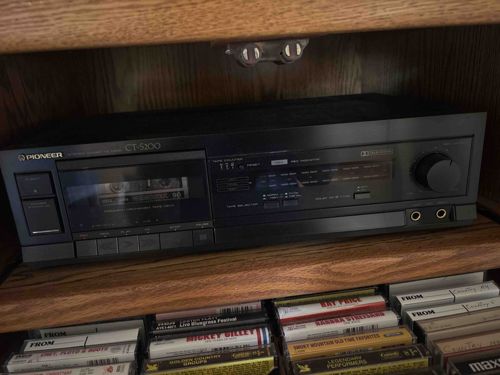
The item is a Pioneer CT-5200 cassette deck, a vintage audio component designed for playing and recording audio cassettes. It features a predominantly black metal casing, characteristic of consumer electronics from the late 1970s to early 1980s. The front panel is made of metal and plastic, with a brushed or matte black finish. On the left side, there is the 'Pioneer' logo and the model number 'CT-5200' printed in white. The large cassette well is visible through a clear plastic door, with a cassette tape inserted, indicating its operational status or recent use. Below the cassette well are several square-shaped control buttons for typical cassette functions like Play, Stop, Rewind, Fast Forward, and Record, likely made of black plastic. To the right of the cassette well, there's an illuminated display panel that shows tape counter information and possibly peak level meters. Above this display, the 'Dolby' logo is visible, indicating Dolby Noise Reduction capabilities. Further to the right, a prominent circular knob, likely for output level or recording level, dominates this section. Below the knob, there are two 1/4-inch headphone or microphone jacks. The unit appears to be housed within a wooden audio cabinet or shelving unit, suggesting it was part of a home stereo system. The overall condition appears to be good for its age, though minor surface wear or dust might be present given its vintage nature and placement. The clear plastic cassette door shows some reflections, but no significant scratches or cracks are immediately apparent. The controls seem intact and functional. The aesthetic is typical of early solid-state hi-fi equipment, prioritizing functionality and clean lines. This model represents a straightforward, quality cassette deck from an established audio manufacturer of its era.
AI Appraisal Report
I have examined the provided image of the Pioneer CT-5200 Cassette Deck. Visually, the unit presents well for a vintage audio component from the late 1970s or early 1980s. The black metal casing and front panel appear to be in good aesthetic condition, with no immediate signs of major damage, deep scratches, or dents. The clear plastic cassette door shows some reflections but no apparent cracks. All visible control buttons and knobs seem intact, suggesting good physical preservation. The presence of the 'Dolby' logo indicates its noise reduction capabilities, which was a desirable feature for its era.
Authenticity, based solely on this image, appears consistent with genuine Pioneer manufacturing for the CT-5200 model. The logos, model number font, and general layout align with known examples of this deck. However, without a physical inspection, I cannot verify internal components, functionality, or any potential modifications. Operational status, whether all functions work correctly (playback, recording, fast forward/rewind, meters, etc.), is impossible to ascertain from an image.
Market conditions for vintage cassette decks vary significantly. While high-end or rare models from brands like Nakamichi can fetch considerable sums, mid-range decks like the CT-5200 are common. Demand is generally driven by collectors, audiophiles seeking specific aesthetics, or those wanting to play old cassette collections. This particular model is not considered rare. Factors impacting value include cosmetic condition, full operational verified functionality, and whether it has been recently serviced. Given its commonality and mid-tier positioning in its original market, its value is modest. Any non-functional aspects would drastically reduce this appraisal. An in-person examination would be critical to confirm full operational status, assess internal condition (e.g., belt integrity, head wear, power supply health), and definitively rule out any non-original parts or undisclosed damage that would affect a precise valuation.