These notes were written by the person who submitted this item. Appraiser.AI has not verified them, and the AI's identification and estimate may rely on them.
AI Estimated Value
Not an official valuation
$15-30
AI estimate as of July 12, 2025 · verify with a professional before acting
AI-Generated · Verify before acting
Everything on this page is generated by AI for informational purposes only. AI can make mistakes — the AI may misidentify items or misattribute them (artist, maker, brand, designer, origin, era). This is not an official valuation and should not be used for insurance, sale, tax, estate, legal, or lending purposes — or any decision requiring a certified appraisal. It is not an authoritative claim about any person, brand, or rights holder — do not share or rely on it as a factual statement about a third party. Always consult qualified professionals before making financial decisions.
This analysis also relies on unverified notes provided by the user, which may be incomplete or inaccurate and could affect the result.
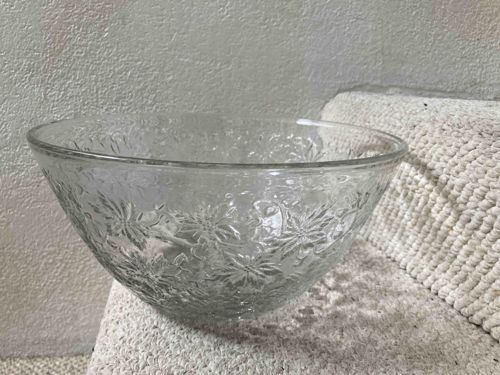
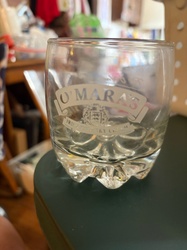
This is a clear glass serving bowl, likely used for salads, fruits, or punches. The bowl features a classic rounded shape with a slightly flared rim. Its primary decorative element is a repeating, embossed pattern of what appears to be leaves or stylized floral motifs, giving it a textured, frosted appearance on the exterior while maintaining a smooth interior for easy cleaning. The glass itself is transparent, allowing light to pass through and highlight the intricate raised designs. The craftsmanship suggests it was mold-pressed, a common manufacturing technique for acquiring consistent, decorative patterns on glass items. There are no immediately visible chips, cracks, or significant abrasions, indicating good overall condition. The rim appears smooth and uniform, devoid of any discernible flaking. The base is not fully visible, but the general shape suggests a stable foundation. Such bowls were popular from the mid-20th century onwards, especially for entertaining, and this specific pattern, resembling a 'crinkle' or 'hobnail' effect with botanical elements, suggests a possible production period from the 1960s to the 1980s. Without a visible maker's mark or specific pattern name, pinpointing an exact manufacturer is difficult, but it aligns with mass-produced pressed glass common during those decades. The quality of the glass appears good, with no obvious bubbles or imperfections in the material itself, speaking to a decent level of manufacturing quality for its type.
AI Appraisal Report
Upon examining the provided image and description of this clear embossed glass serving bowl with a leaf/floral pattern, I assess its condition to be excellent. The absence of visible chips, cracks, or significant abrasions, as described, aligns with what one would expect from a well-preserved piece of utilitarian glassware. The smooth and uniform rim further reinforces this assessment. Its authenticity as a mass-produced pressed glass item from the mid-20th century to late 1980s is highly probable based on its design, manufacturing technique, and typical use. The 'crinkle' or 'hobnail' effect with botanical elements is characteristic of that era.
From a market perspective, clear embossed glass serving bowls, while charming, generally fall into a category of collectible but not highly rare items. Similar items are readily available through online marketplaces, antique malls, and estate sales. Demand is moderate, driven primarily by individuals seeking vintage home decor, functional serving pieces, or occasional collectors of specific pressed glass patterns. Without a visible maker's mark or distinct pattern name, it is difficult to pinpoint a specific manufacturer, which limits its appeal to specialized collectors and consequently its market value. The good quality of the glass, with no obvious bubbles, indicates a decent level of manufacturing for its type.
Factors significantly impacting value include the excellent condition, which is a plus. However, the lack of rarity, clear maker's identification, and moderate demand temper its appraisal value. For full authentication and a more precise valuation, an in-person examination would be necessary to inspect for subtle imperfections, confirm the manufacturing process, and search for faint marks not visible in images. Provenance documentation (e.g., original sales receipts) would also be beneficial but is rarely available for such items. Scientific testing is generally not required for this type of glassware.