These notes were written by the person who submitted this item. Appraiser.AI has not verified them, and the AI's identification and estimate may rely on them.
AI Estimated Value
Not an official valuation
$75 - $150
AI estimate as of October 24, 2025 · verify with a professional before acting
AI-Generated · Verify before acting
Everything on this page is generated by AI for informational purposes only. AI can make mistakes — the AI may misidentify items or misattribute them (artist, maker, brand, designer, origin, era). This is not an official valuation and should not be used for insurance, sale, tax, estate, legal, or lending purposes — or any decision requiring a certified appraisal. It is not an authoritative claim about any person, brand, or rights holder — do not share or rely on it as a factual statement about a third party. Always consult qualified professionals before making financial decisions.
This analysis also relies on unverified notes provided by the user, which may be incomplete or inaccurate and could affect the result.
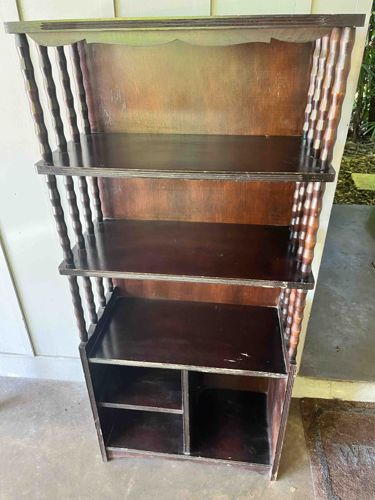
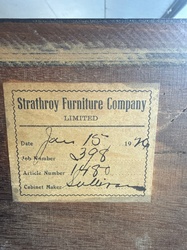
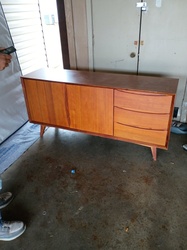
This is a wooden bookshelf, appearing to be crafted from a medium-density wood, possibly pine or a similar timber, stained in a dark, reddish-brown color, akin to a mahogany or walnut finish. The overall height is considerable, likely between 4 to 5 feet, and its width appears to be approximately 2 to 3 feet. The construction features three primary open shelves, with the top two shelves having a scalloped or gently curved decorative trim at the front edge of their backboards. The sides of the bookshelf are a distinct feature, composed of multiple turned wooden spindles that extend from the top trim down to the foot of the unit, providing an open yet structured aesthetic. These spindles have a stacked, tiered design. The lowest section of the bookshelf departs from the open shelf design, presenting a closed-off area with two smaller, horizontally divided compartments on the left, and a single larger, wider compartment on the right. This lower section suggests a possible utility for storing larger, bulkier items or perhaps acting as a small cabinet. The condition is fair, exhibiting visible signs of wear consistent with age and use. There are numerous scuffs, scratches, and chips in the finish, particularly noticeable on the edges of the shelves and the top surface of the lowest section. Some areas show a loss of stain, revealing lighter wood beneath, indicating areas prone to impact or friction. There are no obvious signs of significant structural damage like cracks or breaks, but the overall patina suggests a piece that has been utilized over many years. There are no discernible maker's marks, signatures, or stamps visible in the provided images. The style leans towards a traditional or possibly Victorian-era design, characterized by the turned spindles and the dark wood finish. While not overtly ornate, the spindle work and scalloped trims suggest an attempt at decorative craftsmanship beyond purely utilitarian function. The quality appears to be consumer-grade furniture from its period, rather than high-end artisan work.
AI Appraisal Report
Based on my visual examination of the provided image and the owner's description, this traditional wooden bookshelf with spindle sides is in fair condition. I assess it to be a consumer-grade piece from its period, likely mid to late 20th century, though without direct inspection, the exact age remains unknown. The dark reddish-brown stain, turned spindles, and scalloped trim are consistent with traditional or Victorian-inspired designs popular during that time. Its authenticity as a period piece of consumer furniture seems likely based on the visible construction.
The condition, as described and visually evident, shows significant wear including numerous scuffs, scratches, chips, and areas of stain loss. While there are no obvious structural breaks, the overall ‘patina’ suggests extensive use. This wear significantly impacts its market value. Current market conditions for traditional wooden furniture of this type are generally soft, with a preference for more modern or mid-century designs. Comparables, usually found in antique malls, consignment shops, or online marketplaces, typically range from $100-$300 for pieces in better condition. The multiple open shelves and closed lower compartments offer good practical utility, which adds a functional demand, but rarity is not a factor here; similar pieces were mass-produced. Without any discernible maker's marks or provenance, it's difficult to attribute it to a specific manufacturer which also limits its value.
Limitations in authenticity verification are inherent when working solely from images. A physical examination would allow me to assess the wood type definitively, verify construction techniques (e.g., joinery), and gauge the stability of the structure. I would also look for hidden maker's marks, assess the extent of the finish damage up close, and determine if any repairs have been attempted. Provenance documentation, if available, could provide a more precise age and history, which would add to its historical or sentimental value, but is unlikely to dramatically increase its monetary appraisal given the item's apparent commonality.