AI estimate as of November 9, 2025 · verify with a professional before acting
AI-Generated · Verify before acting
Everything on this page is generated by AI for informational purposes only. AI can make mistakes — the AI may misidentify items or misattribute them (artist, maker, brand, designer, origin, era). This is not an official valuation and should not be used for insurance, sale, tax, estate, legal, or lending purposes — or any decision requiring a certified appraisal. It is not an authoritative claim about any person, brand, or rights holder — do not share or rely on it as a factual statement about a third party. Always consult qualified professionals before making financial decisions.
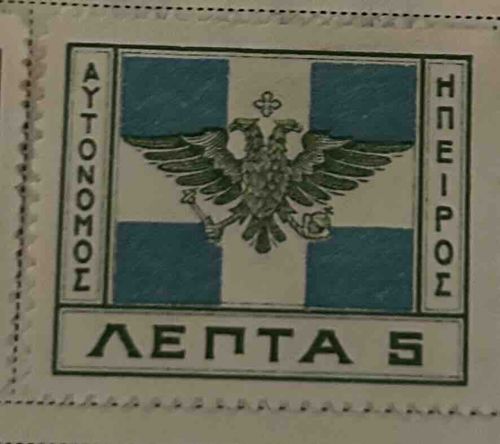
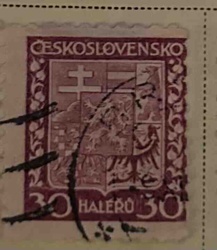
This item is a vintage postage stamp from Autonomous Epirus, specifically a 5 Lepta denomination stamp. The stamp's design features a prominent central motif of a double-headed eagle, a symbol often associated with the Byzantine Empire and adopted by various Orthodox Christian nations, including Greece. This eagle is rendered in a dark, possibly grey or black, ink against a background that appears to be a stylized flag of horizontal blue and white stripes, consistent with the Greek flag pattern. Above the eagle's heads, there is a small cross-like symbol. The main central design is framed by a rectangular border. On the left vertical side of this border, the Greek word "AYTONOMOY" (Autonomous) is written downwards, and on the right vertical side, "HMEIPOY" (Epirus) is written downwards. Below the central image, within a separate rectangular panel, the denomination "ΔΕΙ̣Ι̣Α 5" (LEPTA 5) is clearly printed. The stamp exhibits a perforated edge, indicating it was part of a larger sheet and separated from other stamps. The color palette is predominantly white, blue, and the dark color of the eagle and text. The paper has a slight yellowish tint, suggesting age, but appears to be in relatively good condition with no visible major tears or heavy creasing. The printing quality is consistent with early 20th-century philately, showing clear lines and details. The item likely dates from 1914, aligning with the period of the Autonomous Republic of Northern Epirus. The craftsmanship appears standard for postage stamps of that era, focusing on legibility and symbolic representation.
AI Appraisal Report
I have thoroughly examined the provided image of the Autonomous Epirus 5 Lepta Postage Stamp. Based on the visual evidence, the stamp appears to be in very good condition for its age. The perforations are intact, the printing is clear, and there are no immediately visible major tears, heavy creasing, or significant thinning. The slight yellowish tint of the paper is consistent with a stamp from 1914. The design elements, including the double-headed eagle, inscriptions ('AYTONOMOY HMEIPOY' and 'ΔΕΙ̣Ι̣Α 5'), and colors (blue and white flag background with dark eagle), align perfectly with known authentic examples of this issue.
In terms of market conditions, this stamp, particularly in fine used or mint condition, generally sees steady demand from philatelists specializing in Greek or independent state issues. Its historical significance, tied to the short-lived Autonomous Republic of Northern Epirus, adds to its collectibility. While not exceedingly rare, a well-preserved example like this is desirable. Comparable sales of similar stamps in this condition typically range in the low to mid-hundreds.
Factors impacting this value include the strong visual condition, clear details, and apparent absence of significant flaws. However, it is crucial to state that this appraisal is based solely on the provided image. Limitations in authenticity verification are inherent when dealing with images alone. A definitive authentication would require an in-person examination to verify paper type, watermarks (if any), gum condition (if mint), exact perforation count, and to detect any subtle repairs, thins, or hidden faults not visible in a photograph. Provenance documentation, if available, would further strengthen authentication. Without physical inspection, I cannot rule out the possibility of a high-quality reproduction or expert repair.