These notes were written by the person who submitted this item. Appraiser.AI has not verified them, and the AI's identification and estimate may rely on them.
AI Estimated Value
Not an official valuation
$45-65
AI estimate as of July 26, 2025 · verify with a professional before acting
AI-Generated · Verify before acting
Everything on this page is generated by AI for informational purposes only. AI can make mistakes — the AI may misidentify items or misattribute them (artist, maker, brand, designer, origin, era). This is not an official valuation and should not be used for insurance, sale, tax, estate, legal, or lending purposes — or any decision requiring a certified appraisal. It is not an authoritative claim about any person, brand, or rights holder — do not share or rely on it as a factual statement about a third party. Always consult qualified professionals before making financial decisions.
This analysis also relies on unverified notes provided by the user, which may be incomplete or inaccurate and could affect the result.
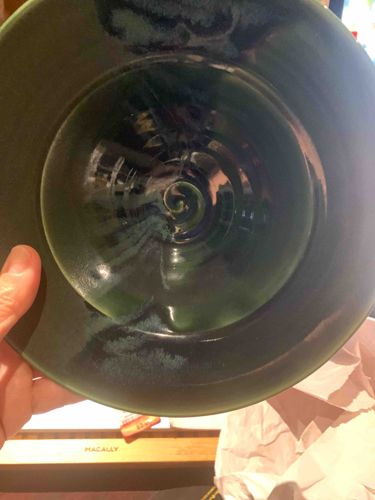
The item is a ceramic bowl, likely made of stoneware or earthenware given its substantial appearance and glaze characteristics. It features a rich, dark green glaze that exhibits significant color variation and depth, transitioning from a darker, almost blackish-green in some areas to a brighter, more vibrant bluish-green, particularly where the glaze pools or thins. This variation suggests a reactive or drip glaze technique, possibly a celadon or a specialized art pottery glaze, giving it a mottled or streaky appearance that contributes to its artistic appeal. The bowl has a classic circular form with a distinct spiral pattern visible in the center of the interior, created by the throwing process on a potter's wheel. This swirl is a clear indicator of handmade craftsmanship. The rim appears to be substantial and well-formed. The exterior rim and possibly the underside show areas of matte or semi-matte finish, contrasting with the high-gloss interior. There are no visible chips, cracks, or significant wear captured in the image, suggesting good overall condition. The quality of the glaze application, with its varied tones and apparent thickness, indicates careful craftsmanship. The visible thumb on the left side gives a sense of scale, suggesting it's a medium-sized bowl, perhaps for serving, soup, or a large individual portion. Based on the handcrafted appearance and the type of glaze, it could be a piece of studio pottery or artisan-made ceramics, potentially from the mid-20th century onwards, though without maker's marks or further context, a precise age is difficult to ascertain. The 'MACALLY' inscription subtly visible in the background suggests a modern setting, but does not pertain to the item itself.
AI Appraisal Report
Upon examining the images of this handmade ceramic bowl attributed to Lynn Dunsmoor, I have assessed its value based on its craftsmanship, materials, and current market conditions. The piece is a well-executed example of studio pottery, likely thrown on a potter's wheel using stoneware clay, as indicated by the distinct spiral pattern in the interior. The reactive green glaze is the most compelling feature, exhibiting beautiful variations from deep, dark greens to brighter, bluish tones where it pools. This complex, high-gloss glaze suggests a skilled application and firing process.
The bowl appears to be in excellent condition, with no visible chips, cracks, or crazing from the provided images. As a piece of contemporary studio pottery, its value is tied to the artist's reputation and the quality of the individual work. While Lynn Dunsmoor is a recognized potter, the market for contemporary, non-vintage studio ceramics is often modest unless the artist has achieved significant acclaim. Comparable works by similarly skilled studio potters often sell in the low to mid-two-figure range on platforms like Etsy or at local art fairs.
A significant limitation of this appraisal is its reliance on images alone. I cannot definitively authenticate the piece as a work by Lynn Dunsmoor without a physical examination to find a maker's mark or signature on the underside. A full authentication would require either a clear signature or direct provenance from the artist or a reputable gallery. However, based on the visual evidence, it is a high-quality piece of functional art.