AI estimate as of August 4, 2025 · verify with a professional before acting
AI-Generated · Verify before acting
Everything on this page is generated by AI for informational purposes only. AI can make mistakes — the AI may misidentify items or misattribute them (artist, maker, brand, designer, origin, era). This is not an official valuation and should not be used for insurance, sale, tax, estate, legal, or lending purposes — or any decision requiring a certified appraisal. It is not an authoritative claim about any person, brand, or rights holder — do not share or rely on it as a factual statement about a third party. Always consult qualified professionals before making financial decisions.
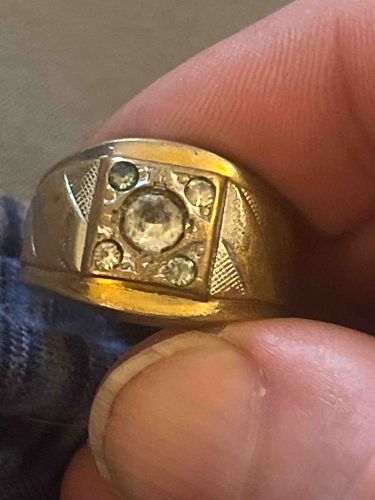
This item is a ring, appearing to be crafted from a golden-toned metal, possibly gold-plated base metal or a low-carat gold alloy, given the visible wear and slight discoloration. The ring features a prominent, square-shaped head, which houses a central, larger, round-cut clear stone, likely a rhinestone or cubic zirconia, surrounded by four smaller, round-cut clear stones. One of the smaller stones, located at the top-left, exhibits a noticeable greenish tint, suggesting either discoloration due to wear, a different type of less stable material, or possibly an inclusion. The stones are set within a bezel-like or flush setting that blends into the surface of the square head. The shoulders of the ring, extending from the square head, feature an engraved or cast pattern resembling a series of diagonal lines forming a zig-zag or chevron design, adding a decorative element to the piece. There is noticeable wear on the metal surface, particularly around the edges and raised areas, indicating frequent use. The overall construction appears solid, with no immediately visible signs of major damage such as cracks or significant deformation, though the clarity and brilliance of the stones are somewhat diminished due to dirt or surface scratches. There are no discernible maker's marks or signatures visible in the provided image. The style suggests it could be a men's ring or a unisex piece, perhaps from the mid to late 20th century, characterized by its bold, somewhat chunky design and the use of clear accent stones. The quality of craftsmanship is moderate, typical of costume jewelry or mass-produced items where the focus is on a statement design rather than fine material value.
AI Appraisal Report
Upon examining the provided image of the Gold-Toned Square Head Ring with Clear Stones, I assess its condition as fair to good, exhibiting clear signs of wear consistent with regular use. The golden-toned metal shows surface abrasions and some discoloration, particularly around the edges, suggesting it is likely gold-plated or a low-carat gold alloy rather than solid high-karat gold. The central and surrounding clear stones, likely rhinestones or cubic zirconia, exhibit diminished brilliance, which I attribute to surface scratches and accumulated dirt. The notable greenish tint on one smaller stone points to potential material instability or extensive wear, diminishing its aesthetic appeal. Authenticity as a fine jewelry piece is not supported; its appearance aligns more with costume jewelry or a mass-produced item.
Given the visible wear, the non-precious nature of the stones (implied by their appearance and the discolored stone), and the likely base metal composition, the market for this type of item is limited. Comparables would include vintage costume jewelry rings from the mid to late 20th century. Demand for such pieces is generally low, unless they are exceptionally rare designer pieces or exhibit unique historical significance, neither of which appears to be the case here. Factors significantly impacting value are the material composition (non-precious), condition (moderate wear), and lack of identifying marks.
Without physical inspection, I cannot definitively confirm the metal type, exact stone composition, or the presence of any hidden marks. A magnet test, specific gravity test, or acid test would be necessary to confirm the metal. Gemological testing would be required to identify the stones (e.g., refractive index for cubic zirconia vs. glass). Furthermore, the absence of maker's marks prevents any attribution to a specific designer or era without external documentation. Such in-person examination and testing are crucial for precise authentication and valuation.