These notes were written by the person who submitted this item. Appraiser.AI has not verified them, and the AI's identification and estimate may rely on them.
AI Estimated Value
Not an official valuation
$150-250
AI estimate as of October 3, 2025 · verify with a professional before acting
AI-Generated · Verify before acting
Everything on this page is generated by AI for informational purposes only. AI can make mistakes — the AI may misidentify items or misattribute them (artist, maker, brand, designer, origin, era). This is not an official valuation and should not be used for insurance, sale, tax, estate, legal, or lending purposes — or any decision requiring a certified appraisal. It is not an authoritative claim about any person, brand, or rights holder — do not share or rely on it as a factual statement about a third party. Always consult qualified professionals before making financial decisions.
This analysis also relies on unverified notes provided by the user, which may be incomplete or inaccurate and could affect the result.
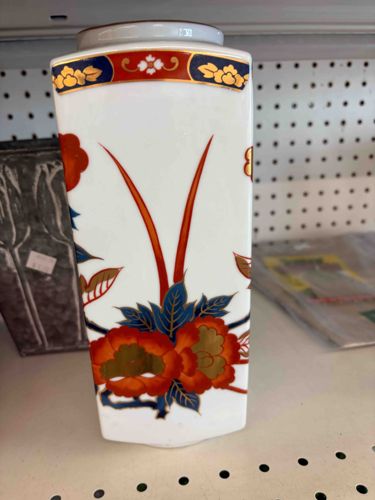
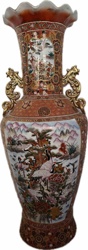
This item is a Japanese Imari style porcelain square vase, characterized by its predominantly white body adorned with intricate polychrome and gilt decoration. The vase has a rectangular or square cross-section, flaring slightly at the top to a round, unadorned rim. The primary color palette includes vibrant iron red, cobalt blue, and gold accents, common in Imari ware. \n\nThe upper portion of the vase features a decorative band with a dark blue background punctuated by gold floral motifs, separated by a red band with white floral or scroll-like patterns. Below this, the main body displays a dynamic floral arrangement. Two prominent orange-red flowers with golden centers are depicted at the base, surrounded by deep blue leaves and brown, leaf-like accents. Slender, upright orange-red stalks extend upwards from these flowers, suggesting bamboo or similar stylized vegetation. Additional, less defined floral elements in similar colors appear to extend around the sides of the vase, implying a continuous design rather than a single panel. \n\nThe material appears to be fine-grained porcelain, offering a smooth, glossy surface typical of Japanese ceramic production. The craftsmanship exhibits detailed brushwork and a careful application of glazes and gilding. Based on the decorative style, particularly the use of gold and specific color palette, it strongly aligns with late 19th to mid-20th century Japanese Imari tradition. The term 'Amari' mentioned in the context likely refers to 'Imari,' a well-known style of Japanese porcelain. \n\nVisible condition issues from the image are minimal. The surface appears largely intact, without obvious chips, cracks, or significant wear to the glaze or painted details. The white background might have some minor smudges or dust, but these appear superficial. The overall presentation indicates a piece in good, well-preserved condition. The rim is a simple, unadorned circle, finished in a light gray or off-white tone, contrasting subtly with the decorated body.
AI Appraisal Report
This Japanese Imari Style Porcelain Square Vase presents as a visually appealing piece with intricate polychrome and gilt decoration. Based on the provided image, the condition appears good, with no obvious chips, cracks, or significant wear to the glaze or painted details. The colors are vibrant, and the gilding seems largely intact. The 'Amari' inscription likely refers to a variation or misspelling of 'Imari,' a well-established style. The decorative style, characterized by the use of iron red, cobalt blue, and gold accents, consistent with late 19th to mid-20th century Japanese Imari tradition, suggests a piece manufactured during this period for export markets.
In terms of market conditions, similar Imari-style vases from this period, especially those without specific artist or kiln marks, tend to fall into a modest price range. While they are decorative and appealing, they are not exceedingly rare, and the demand is steady rather than fervent. Factors impacting value include the good condition and the detailed, continuous design.
It is important to note that this assessment is based solely on the provided image. A full authentication would require in-person examination to verify the porcelain body, detect any hairline cracks or repairs not visible in photographs, and confirm the quality of the gilding and enamels. Additionally, provenance documentation would provide further historical context, though it's typically less critical for pieces of this decorative nature. Scientific testing could confirm material composition but is generally not economically warranted for items in this price bracket.