AI estimate as of October 6, 2025 · verify with a professional before acting
AI-Generated · Verify before acting
Everything on this page is generated by AI for informational purposes only. AI can make mistakes — the AI may misidentify items or misattribute them (artist, maker, brand, designer, origin, era). This is not an official valuation and should not be used for insurance, sale, tax, estate, legal, or lending purposes — or any decision requiring a certified appraisal. It is not an authoritative claim about any person, brand, or rights holder — do not share or rely on it as a factual statement about a third party. Always consult qualified professionals before making financial decisions.
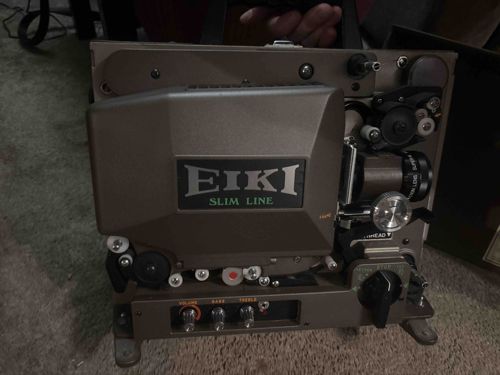
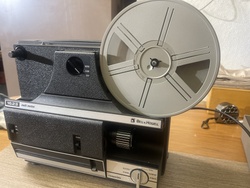
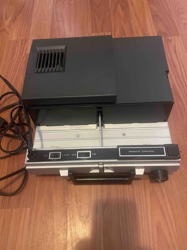
The item is an Eiki Slim Line 16mm film projector, characterized by its robust, industrial design. The primary color scheme is a mottled dark bronze or brown, indicative of heavy-duty, professional-grade equipment. The projector's chassis appears to be constructed primarily of metal, likely cast aluminum or steel, given its rigid structure and durability typically associated with such devices from the mid-to-late 20th century. A prominent feature is the large, rectangular cover on the left side, bearing the 'EIKI' logo in a stylized font with 'SLIM LINE' beneath it, both in contrasting colors against a dark background, likely a decal or etched plate. Numerous mechanical components are visible on the right side and front, including a complex array of rollers, guides, and sprockets for film threading, all appearing to be made of black plastic or rubber and polished metal. The lens assembly is dark-colored, possibly black or dark gray, with visible text indicating 'PROJECTION LENS' and 'SUPER' along with some numerical markings, suggesting specific optical properties. A large, knurled silver knob is prominent near the lens, likely for focus adjustment. Below the main body on the front, there's a control panel inset with several knobs and switches. From left to right, these include 'VOLUME', 'BASS', and 'TREBLE' controls, implying an integrated audio amplifier system. These knobs are dark with silver caps, and the associated switch toggles are also dark. The overall condition appears to be good with some minor signs of age and use, such as light scuffs or dust, but no major damage or corrosion is immediately evident. The craftsmanship suggests a commercial or educational application, prioritizing durability and functionality. The design points to a mid-20th century (possibly 1960s-1980s) manufacturing period, consistent with the widespread use of 16mm film projectors.
AI Appraisal Report
Based on my visual examination of the Eiki Slim Line 16mm Film Projector, it presents in good overall condition for its age. The robust, industrial design in mottled dark bronze/brown suggests a durable, professional-grade unit, likely constructed of metal (cast aluminum/steel). The 'EIKI SLIM LINE' branding is clear, and all visible mechanical components, film path rollers, and the lens assembly appear intact, showing only minor signs of age and use like scuffs or dust, consistent with a well-maintained vintage piece. The presence of 'VOLUME', 'BASS', and 'TREBLE' controls indicates an integrated audio system. Authenticity is strongly suggested by the prominent branding and characteristic mid-20th century design (likely 1960s-1980s) typical of 16mm projectors from this era. Market conditions for vintage 16mm projectors like this Eiki Slim Line are generally moderate. While once essential, their utility has largely been replaced by digital formats, reducing demand to niche collectors, film enthusiasts, or prop masters. Rarity is not a significant factor here; Eiki was a common manufacturer. The primary value drivers are its functional completeness (assuming it powers on and operates), cosmetic condition, and the integrated audio. Without powering on the unit or testing its lamp, motor, and sound system, functionality cannot be verified, which significantly impacts value. For full authentication and a definitive assessment, an in-person examination would be critical to test all mechanical and electrical functions, verify the integrity of internal components, and assess lens clarity and lamp life. Provenance documentation (original purchase receipts, service records) would also enhance certainty regarding its history and authenticity beyond what images alone can provide.