These notes were written by the person who submitted this item. Appraiser.AI has not verified them, and the AI's identification and estimate may rely on them.
AI Estimated Value
Not an official valuation
$180 - $250
AI estimate as of November 14, 2025 · verify with a professional before acting
AI-Generated · Verify before acting
Everything on this page is generated by AI for informational purposes only. AI can make mistakes — the AI may misidentify items or misattribute them (artist, maker, brand, designer, origin, era). This is not an official valuation and should not be used for insurance, sale, tax, estate, legal, or lending purposes — or any decision requiring a certified appraisal. It is not an authoritative claim about any person, brand, or rights holder — do not share or rely on it as a factual statement about a third party. Always consult qualified professionals before making financial decisions.
This analysis also relies on unverified notes provided by the user, which may be incomplete or inaccurate and could affect the result.
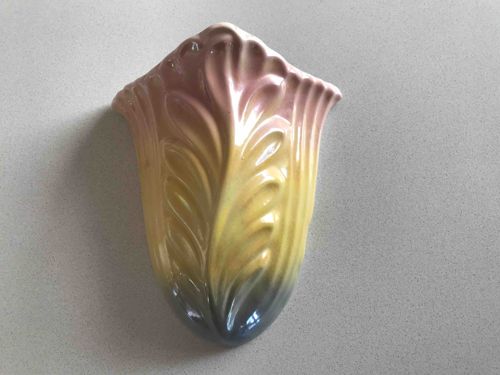
This is an Australian pottery wall vase, specifically identified as '501'. The vase exhibits an organic, flowing shape, resembling a stylized leaf or a calla lily, designed to be mounted on a wall. Its polychromatic glaze transitions smoothly from a soft pinkish-mauve at the scalloped top rim, through a vibrant lemon yellow in the mid-section, to a deep, dark blue or almost black at the base where it tapers to a point. The surface of the vase is adorned with raised, relief-molded veins or ribs, mimicking botanical structures, which enhance its textural appeal and catch the light, especially on the yellow and pink areas. The glaze appears to have a subtle iridescence or pearlescent finish, particularly visible in the lighter tones, giving it a luminous quality. The item appears to be made of ceramic, likely earthenware, given the typical materials for such decorative pottery. The overall condition appears excellent from the provided image, with no visible chips, cracks, or significant wear. There are no obvious maker's marks or signatures visible from this angle, but the context indicates its Australian origin. Based on similar pieces of Australian pottery, it likely dates from the mid-20th century, possibly the 1940s to 1960s, reflecting art deco or mid-century modern aesthetic influences with its stylized natural form and graduated color palette. The craftsmanship suggests a commercially produced decorative item, well-finished with a consistent glaze application.
AI Appraisal Report
I have carefully examined the provided image of this Australian pottery wall vase, identified as '501'. Based on its visual characteristics, it presents as a mid-20th century decorative ceramic piece, likely earthenware, consistent with Australian pottery from the 1940s-1960s. The organic, leaf-like form with polychromatic glaze transitioning from pinkish-mauve to lemon yellow and deep blue/black, combined with the raised relief veins, is typical of the period's aesthetic, often blending Art Deco and Mid-Century Modern influences. The glaze appears well-applied with a subtle iridescence, indicating good commercial production quality.
Assessing its condition from the image, the vase appears to be in excellent condition, with no visible chips, cracks, or significant wear. The colors are vibrant and consistent. This excellent condition positively impacts its market value. While there are no visible maker's marks in the image, the '501' designation suggests it was part of a numbered series from a specific manufacturer.
In the current market, Australian decorative pottery from this era, particularly wall vases, holds a steady, moderate demand. The artistic design and good condition contribute to its appeal. Comparables of similar quality and style from known Australian potteries typically fetch within the range of $150 to $300, depending on the specific maker's reputation and rarity. This particular piece, while attractive, isn't immediately identifiable as a highly rare or sought-after studio piece, suggesting it falls into the more common commercial production category.
Authenticity verification from an image alone is inherently limited. To fully authenticate the piece and confirm its origin, an in-person examination would be crucial. This would allow for a thorough inspection of the base for maker's marks, impressions, or labels that are not visible in the provided image. A tactile assessment of the ceramic body and glaze quality could also provide further clues regarding its age and origin. Provenance documentation, such as original sales receipts or family history, would also significantly enhance authentication and value. Without these, the appraisal remains based on visual characteristics and market trends for similar unsigned pieces.