These notes were written by the person who submitted this item. Appraiser.AI has not verified them, and the AI's identification and estimate may rely on them.
AI Estimated Value
Not an official valuation
$50 - $150
AI estimate as of November 17, 2025 · verify with a professional before acting
AI-Generated · Verify before acting
Everything on this page is generated by AI for informational purposes only. AI can make mistakes — the AI may misidentify items or misattribute them (artist, maker, brand, designer, origin, era). This is not an official valuation and should not be used for insurance, sale, tax, estate, legal, or lending purposes — or any decision requiring a certified appraisal. It is not an authoritative claim about any person, brand, or rights holder — do not share or rely on it as a factual statement about a third party. Always consult qualified professionals before making financial decisions.
This analysis also relies on unverified notes provided by the user, which may be incomplete or inaccurate and could affect the result.
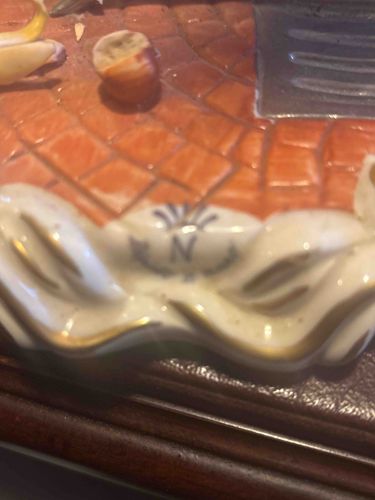
This item appears to be a fragment or a detailed base component of a larger ceramic figurine, likely a clown figurine as indicated by the context. The piece is crafted from glazed ceramic or porcelain, exhibiting a rich, glossy finish. A dominant feature is the orange-red tiled flooring, meticulously rendered with individual brick-like forms, suggesting a realistic setting for the figurine. The tile pattern is well-defined, and the color is vibrant, indicating good preservation. A small, irregularly shaped object, possibly a piece of fruit or another miniature accessory, is visible on the tiled surface, further enhancing the realism and intricacy of the piece. To the left, a portion of a yellow, curved element, possibly another accessory or part of the figurine's attire, is discernable.
A key distinguishing element is the decorative base upon which the tiled surface rests. This base is white or off-white, characterized by undulating, drapery-like folds and accentuated with a delicate gold trim along its edges, indicative of fine craftsmanship. Centrally located on this white section is a blue manufacturer's mark. It consists of a stylized 'N' surmounted by a crown-like motif or a cluster of floral elements, enclosed within a wreath or scroll design. This mark is highly suggestive of Capodimonte porcelain, a renowned Italian manufacturer known for its exquisite porcelain and ceramic figures. The presence of the 'Made in Italy' context further supports this attribution. The entire ceramic piece sits on a polished wooden base, which has a rich, dark brown color and a subtle sheen, suggesting a sturdy and aesthetically pleasing display. Visible condition issues are minimal; the glaze appears intact, and colors are vibrant, though the overall item is only partially shown.
AI Appraisal Report
I have examined the provided image of what appears to be a base component or fragment of a Capodimonte-style clown figurine. Based on the visual evidence, the ceramic element presents in very good condition with vibrant colors and an intact glaze, suggesting careful preservation. The detailed orange-red tiled flooring, the small accessory, and the yellow curved element all point to a high level of craftsmanship. The white, drapery-like base with gold trim and, crucially, the blue manufacturer's mark featuring a stylized 'N' surmounted by a crown or floral cluster within a wreath strongly indicate attribution to Capodimonte or a Capodimonte-style manufacturer from Italy, a claim supported by the 'Made in Italy' context. The polished wooden base further enhances its display value.
However, this item is a component, not a complete figurine. This significantly impacts its market value. While Capodimonte figurines are generally collectible, individual bases or fragments typically hold much less value than complete, intact pieces. Current market conditions for ceramic figurines, including Capodimonte, show a moderate demand for complete, well-preserved examples by known artists or specific series. Fragments or bases primarily attract collectors who might be seeking to restore a damaged piece or acquire a collectible curiosity. Rarity is difficult to assess for a component without knowing the original complete figurine.
My appraisal reflects that this is a detailed and well-crafted fragment from a reputable Italian ceramic tradition. The primary factor diminishing its value is its incompleteness. For full authentication and to ascertain the specific Capodimonte factory (as several used variations of the 'N' mark), an in-person examination of the mark for clarity, a review of provenance documentation, and potentially scientific testing of the ceramic body would be essential. Without the complete figurine, the intrinsic artistic and collectible value is substantially reduced.