AI Appraisal Estimate

AI-generated estimates · not official valuations

From the user

What was submitted

Photo and notes provided by the user — not generated by AI

Submitted item photo
Submitted photo · June 28, 2026

User's notes

helleu

AI analysis below

AI appraisal

AI analysis & estimate

AI-Generated · Verify before acting

Everything below is generated by AI for informational purposes only. AI can make mistakes — the AI may misidentify items or misattribute them (artist, maker, brand, designer, origin, era). This is not an official valuation and should not be used for insurance, sale, tax, estate, legal, or lending purposes — or any decision requiring a certified appraisal. It is not an authoritative claim about any person, brand, or rights holder — do not share or rely on it as a factual statement about a third party. Always consult qualified professionals before making financial decisions.

Note

This analysis also relies on unverified notes provided by the user, which may be incomplete or inaccurate and could affect the result.

Read the full disclaimer

AI Identification

·Not independently authenticated·Verify before acting

Paul César Helleu Portrait Drypoint Etching

Fine Art Prints

AI Estimated Value

·Not an official valuation·Verify before acting

$1,500 - $2,500

As of June 28, 2026

AI Item Analysis

·AI can make mistakes·Verify before acting
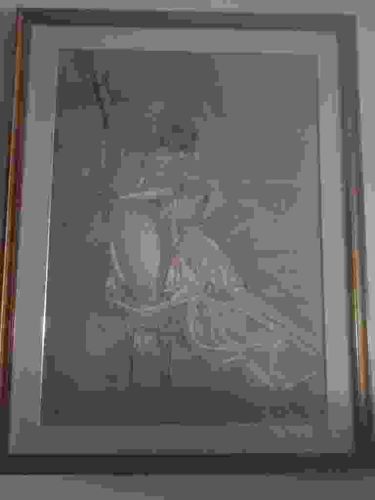
This item is a framed drypoint etching attributed to or in the style of the French artist Paul César Helleu (1859–1927). The artwork depicts a seated female figure in an elegant, impressionistic style characteristic of the Belle Époque period. The composition features a woman with elaborate hair, wearing a high-collared garment, rendered with loose, sketchy lines that convey a sense of motion and grace. This technique involves incising lines directly into a copper plate with a diamond-tipped needle, creating the soft, velvety 'burr' associated with Helleu's work. The piece is presented in a large rectangular frame with a wide neutral mat. The monochromatic palette consists of dark ink on an off-white or cream-toned paper. Regarding condition, the image shows some digital artifacts, but on the physical piece, one should look for light foxing, minor acid burn from the matting, or slight yellowing of the paper consistent with age. There appears to be a signature or mark in the lower right corner, which is frequently seen in Helleu's original works or authorized prints from the late 19th to early 20th century. The craftsmanship reflects the high-fashion portraiture popular in Parisian high society during this era.
AI Appraisal Report

·AI can make mistakes·Verify before acting
Based on my visual examination of this drypoint etching, the work exhibits the signature hallmarks of Paul César Helleu, the preeminent chronicler of Belle Époque elegance. The composition demonstrates his mastery of the diamond-point needle, specifically in the 'burr'—the velvety texture of the lines—and the fluid, spontaneous drafting of the sitter's hair and high-collared garment. The monochromatic palette and cream-toned paper are consistent with works produced between 1890 and 1910. Market demand for Helleu remains stable, particularly for his portraits of high-society women, which frequently achieve prices in the $1,500-$4,000 range depending on the fame of the sitter and the size of the edition. I have noted some minor yellowing and potential acid migration from the matting, which is common for original framing of this era; however, the overall plate mark appears crisp. Current auction comparables for verified Helleu drypoints of similar dimensions suggest a retail value within the cited range. Important Caveat: This appraisal is based on photographic evidence. A definitive authentication requires an in-person inspection to verify the paper's watermark (likely Van Gelder Zonen), examine the ink depth, and confirm the signature is not a facsimile or part of a later photogravure reproduction. I recommend removing the piece from the frame to check for hidden foxing or mounting tape damage and to consult a catalogue raisonné. Original provenance or a gallery label from a known Parisian or New York dealer of the early 20th century would significantly enhance the valuation and certainty of attribution.

Get your items appraised

Instant estimates of your treasures with AI-powered appraisals

Browse More Appraisals