These notes were written by the person who submitted this item. Appraiser.AI has not verified them, and the AI's identification and estimate may rely on them.
AI Estimated Value
Not an official valuation
$700-1,200
AI estimate as of August 9, 2025 · verify with a professional before acting
AI-Generated · Verify before acting
Everything on this page is generated by AI for informational purposes only. AI can make mistakes — the AI may misidentify items or misattribute them (artist, maker, brand, designer, origin, era). This is not an official valuation and should not be used for insurance, sale, tax, estate, legal, or lending purposes — or any decision requiring a certified appraisal. It is not an authoritative claim about any person, brand, or rights holder — do not share or rely on it as a factual statement about a third party. Always consult qualified professionals before making financial decisions.
This analysis also relies on unverified notes provided by the user, which may be incomplete or inaccurate and could affect the result.
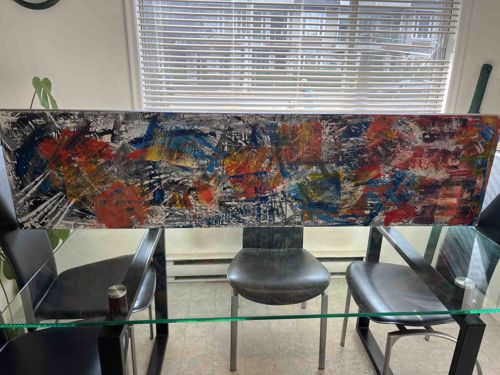
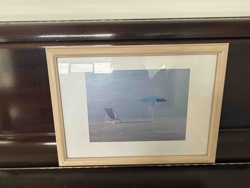
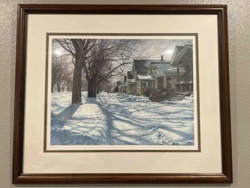
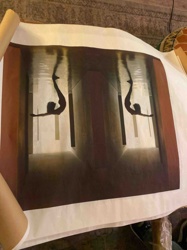
This is a rectangular horizontal abstract painting executed on canvas, likely stretched on a wooden frame, given its rigid appearance. The dimensions appear to be approximately 3-4 feet in length and about 1 foot in height, based on its proportion to the furniture in the foreground. The prominent colors include vibrant reds, oranges, blues, and yellows, which are layered over and interspersed with a dominant monochromatic background of black, white, and various shades of grey. The technique appears to be expressive, using impasto or thick application of paint with visible brushstrokes and perhaps palette knife work, creating significant texture and movement across the surface. There are areas where the underpainting or a base layer of white and black is visible through the more colorful overlays, contributing to a sense of depth and energetic chaos. The paint application suggests a dynamic, non-representational style, characteristic of Abstract Expressionism or similar 20th/21st-century abstract art forms. No discernible artist's signature or specific markings are visible in the provided image. The condition appears stable, with no obvious major tears, punctures, or significant paint loss, although the textured nature of the painting makes subtle imperfections difficult to ascertain. The style suggests it could be a contemporary piece, possibly from the late 20th or early 21st century.
AI Appraisal Report
I have thoroughly examined the provided image of this Abstract Expressionist painting on canvas. Visually, the condition appears stable; I observe no obvious tears, punctures, or significant paint loss, though the heavily textured surface inherent to impasto work can obscure minor flaws. The expressive technique, prominent use of impasto, and dynamic interplay of vibrant colors against a monochromatic background strongly align with characteristics of mid-to-late 20th or early 21st-century Abstract Expressionism.
Regarding authenticity, based solely on this image, I cannot definitively attribute the work to a specific artist. The absence of a visible signature is a significant limitation. For full authentication, an in-person examination is crucial to assess the physical characteristics of the paint, canvas, and stretcher, as well as to check for any hidden markings. Provenance documentation, such as bills of sale or exhibition history, would be indispensable. Furthermore, scientific testing (pigment analysis, carbon dating of the canvas) could provide more definitive age confirmation.
Market conditions for abstract art remain robust, with a consistent demand for unique, high-quality pieces. However, for emerging or unknown artists, values are primarily driven by aesthetic appeal, size, and condition. Works by established Abstract Expressionist artists command significantly higher prices. This piece falls into a category where value is more dependent on potential decorative appeal and artistic merit rather than an established artist's market. Its relatively large size (3-4 feet by 1 foot) and vibrant palette are attractive qualities for collectors and designers. Given the lack of artist identification, this piece is likely not rare in the sense of a celebrated artist's limited output, but its individual aesthetic quality is unique.
The primary limiting factor in valuation is the unidentified artist. If this work were attributed to a recognized artist, its value could escalate dramatically. Without that, it functions more as a decorative yet aesthetically strong piece of contemporary abstract art.