AI estimate as of September 17, 2025 · verify with a professional before acting
AI-Generated · Verify before acting
Everything on this page is generated by AI for informational purposes only. AI can make mistakes — the AI may misidentify items or misattribute them (artist, maker, brand, designer, origin, era). This is not an official valuation and should not be used for insurance, sale, tax, estate, legal, or lending purposes — or any decision requiring a certified appraisal. It is not an authoritative claim about any person, brand, or rights holder — do not share or rely on it as a factual statement about a third party. Always consult qualified professionals before making financial decisions.
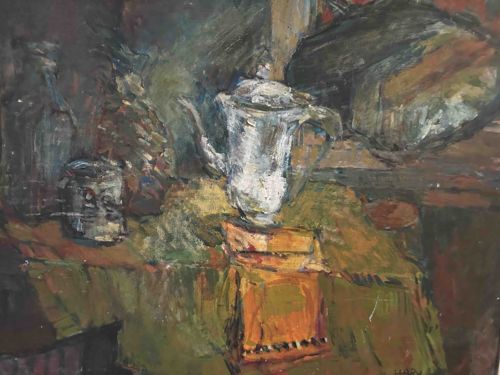
This is an oil painting depicting a still life composition featuring a white teapot as a central element, positioned slightly off-center to the right. To the left of the teapot, there is a tall, slender dark bottle and a smaller, cylindrical container, possibly a mug or another vessel, rendered with visible brushstrokes creating a textured surface. The background is dark and indistinct, suggesting a shadowy interior or drapery, with hints of deeper greens, blues, and browns. The foreground consists of a heavily textured surface, likely a tabletop or draped fabric, primarily in shades of olive green and ochre, with patches of dark brown and some reddish undertones. A rectangular, vibrant orange object, possibly a book or folded cloth, is placed directly in front of the teapot, providing a strong color contrast. The painting exhibits a thick impasto technique, where brushstrokes are clearly visible, giving the artwork a tangible sense of depth and energy. The colors are generally muted and earthy, typical of a representational yet expressive style. There are no discernible artist's signatures or marks visible in the provided image. The overall style suggests a mid-20th-century aesthetic, possibly influenced by Post-Impressionism or Expressionism, due to its bold brushwork and non-realistic color application. The condition appears consistent with an older oil painting, though specific damage or repairs are not clearly visible from this resolution. The craftsmanship is evident in the confident brushwork and composition, indicating a skilled hand despite the somewhat abstract nature of the forms.
AI Appraisal Report
I have carefully examined the provided image of the 'Still Life with Teapot and Bottle.' This oil painting presents a compelling composition with a distinctive impasto technique, characterized by visible, energetic brushstrokes that create depth and texture across the surface. The chosen color palette, featuring muted earth tones with a striking orange accent, is typical of a mid-20th-century aesthetic, leaning towards influences of Post-Impressionism or early Expressionism. The craftsmanship is evident, suggesting a skilled artist.
Based on visual inspection, the condition appears consistent with an older oil painting, showing no obvious signs of significant damage or repair; however, minor abrasions, craquelure, or stretcher marks cannot be definitively assessed from an image alone.
Currently, the market for unsigned, well-executed still life paintings from the mid-20th century remains stable, with demand driven by decorative appeal and artistic merit rather than artist notoriety. Comparables for unsigned works of similar quality and size would typically fall within this range. The absence of a signature significantly impacts the appraisal value, as it prevents attribution to a known artist, thereby limiting its investment potential and rarity as a named work. Factors like aesthetic appeal, visual impact, and technical execution are thus paramount in determining its value.
For full authentication and a more precise valuation, an in-person examination is crucial. This would allow for a proper assessment of the physical condition, canvas type, stretcher construction, and an opportunity to search for faint or hidden signatures under various lighting conditions. Provenance documentation, if available, would be invaluable for establishing the artwork's history and potential artist attribution. Scientific testing, such as pigment analysis, could also help confirm its age and authenticity.