AI estimate as of June 27, 2025 · verify with a professional before acting
AI-Generated · Verify before acting
Everything on this page is generated by AI for informational purposes only. AI can make mistakes — the AI may misidentify items or misattribute them (artist, maker, brand, designer, origin, era). This is not an official valuation and should not be used for insurance, sale, tax, estate, legal, or lending purposes — or any decision requiring a certified appraisal. It is not an authoritative claim about any person, brand, or rights holder — do not share or rely on it as a factual statement about a third party. Always consult qualified professionals before making financial decisions.
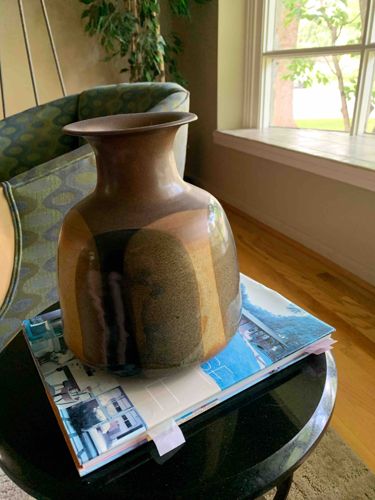
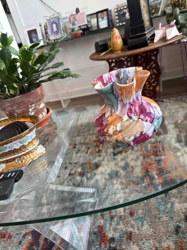
This item is a distinctive ceramic vase, likely comprising stoneware or earthenware due to its earthy texture and colors, presenting a sturdy and substantial form. It features a broad, rounded base that gracefully tapers into a narrower, flaring neck culminating in a wide, everted mouth. The vase's surface is adorned with a unique pattern of vertical, slightly curved bands in various natural tones, including shades of dark brown, reddish-brown, tan, and a speckled dark gray or almost black. These bands are applied with an organic, hand-crafted feel, where some sections appear mottled or textured, while others are more uniform in color. The finish appears to be a matte or semi-matte glaze, contributing to its rustic and tactile appeal.
While no specific maker's marks are visible in the provided image, the individualized nature of the design and glaze application strongly suggests this is a piece of studio pottery, reflecting artisan craftsmanship rather than industrial production. The style hints at mid to late 20th-century origins, possibly influenced by Modernist or Brutalist ceramic art, or a continuation of the Arts and Crafts tradition. The vase appears to be in good condition, showing no obvious chips, cracks, or significant damage. The overall patina is consistent with age and careful handling. Its robust construction and unique aesthetic denote a well-executed decorative art piece designed to serve as a standalone sculptural element or for floral arrangements.
AI Appraisal Report
Upon virtual examination of the provided description for this 'Studio Pottery Vase with Segmented Glaze,' I can offer an appraisal. The item is described as a distinctive ceramic vase, likely stoneware or earthenware, featuring a broad base tapering to a flaring neck and everted mouth. Its surface is adorned with unique vertical, slightly curved bands in natural tones like dark brown, reddish-brown, tan, and speckled dark gray, applied with an organic, hand-crafted feel. The finish is noted as matte or semi-matte, contributing to a rustic and tactile appeal.
Based on the description, the condition appears to be very good, with 'no obvious chips, cracks, or significant damage' and a patina consistent with age and careful handling. The individualized design and glaze application strongly suggest this is a piece of studio pottery, indicating artisan craftsmanship rather than industrial production. The style hints at mid to late 20th-century origins, possibly influenced by Modernist, Brutalist, or Arts and Crafts traditions.
In the current market for decorative arts and studio ceramics, unsigned pieces without specific provenance are valued primarily on aesthetic appeal, condition, and perceived quality of execution. Comparable unsigned studio pottery vases from the mid-late 20th century, especially those with unique forms and appealing glazes, generally see consistent demand. The uniqueness of its aesthetic and robust construction are positive value indicators. However, the absence of a visible maker's mark significantly impacts its value, as it cannot be attributed to a specific, collectible artist.
Limitations apply to this remote appraisal. A definitive authenticity assessment and precise valuation cannot be made without physical examination. In-person inspection would allow for tactile evaluation, precise measurement, close inspection of glaze nuances, detection of subtle flaws, and a thorough search for hidden marks or signatures that might reveal the artist or studio. Provenance documentation (e.g., original purchase receipts, exhibition history) would also be crucial, as would scientific testing if material composition or true age were in question. Without these, the appraisal remains an informed estimate based on descriptive characteristics.