These notes were written by the person who submitted this item. Appraiser.AI has not verified them, and the AI's identification and estimate may rely on them.
AI Estimated Value
Not an official valuation
$1,800 - $2,500
AI estimate as of November 30, 2025 · verify with a professional before acting
AI-Generated · Verify before acting
Everything on this page is generated by AI for informational purposes only. AI can make mistakes — the AI may misidentify items or misattribute them (artist, maker, brand, designer, origin, era). This is not an official valuation and should not be used for insurance, sale, tax, estate, legal, or lending purposes — or any decision requiring a certified appraisal. It is not an authoritative claim about any person, brand, or rights holder — do not share or rely on it as a factual statement about a third party. Always consult qualified professionals before making financial decisions.
This analysis also relies on unverified notes provided by the user, which may be incomplete or inaccurate and could affect the result.
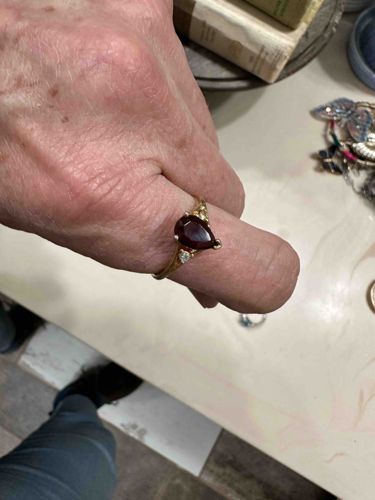
This item is a ladies' ring, likely crafted from yellow gold due to its warm, rich metallic color, supporting the 'Gold Ruby ring' context provided. The central focus of the ring is a prominent pear-cut gemstone, which appears to be a natural ruby based on its deep, saturated reddish-purple hue and the context provided. The ruby is set into a bezel or semi-bezel type setting, securely holding it in place. Flanking the central ruby on either side are two smaller, round brilliant-cut gemstones, which, due to their clear, sparkling appearance, are likely diamonds or diamond simulants, set in what appears to be a prong or bead setting. Each of these side stones is nestled within a stylized, possibly floral or leaf-like element, adding to the decorative appeal of the ring's shoulders. The band of the ring is simple and polished, tapering slightly towards the back. The overall design suggests a vintage or classic aesthetic, possibly dating from the mid-20th century onwards, given the stone cuts and mounting style. No obvious damage such as chips, cracks, or significant abrasions are visible on the gemstones or the metalwork, although a detailed inspection under magnification would be necessary to confirm. The metal shows a gentle patina consistent with wear but no severe scratches or dents are discernible from the image. The craftsmanship appears to be of standard jewelry quality, with smoothly finished bezels and prongs.
AI Appraisal Report
Based on my visual examination of the provided image and the owner's details, the ladies' ring presents as a charming piece, likely crafted in yellow gold. The central feature, a pear-cut gemstone, exhibits a deep, rich reddish-purple hue consistent with a natural ruby, as also suggested by the owner. It is securely set in what appears to be a bezel or semi-bezel setting. Flanking this ruby are two smaller, round brilliant-cut stones, which, given their sparkle and context, I assess are likely diamonds. These are set within stylized, possibly floral elements, enhancing the ring's classic aesthetic. The metalwork appears well-maintained with a gentle patina, and I observe no obvious damage such as significant chips, cracks, or abrasions to the gemstones or metal from the image provided.
In terms of market conditions, ruby and diamond gold rings, especially those with a vintage or classic appeal, maintain a steady demand. The pear cut of the ruby adds a distinctive touch. Comparables for similar gold rings featuring a prominent ruby (assumed natural) and diamond accents typically range depending on the precise carat weight and quality of the stones, as well as the gold purity.
However, it is crucial to state the limitations of an image-based appraisal. While the color is indicative, definitive authenticity of the ruby (natural vs. synthetic, and clarity/treatment) and the diamonds (natural vs. simulant) cannot be guaranteed without in-person examination, professional gemological testing (e.g., refractive index, specific gravity, spectroscopy), and magnification. Similarly, the exact carat weight of the stones and the purity of the gold cannot be confirmed without physical inspection and proper measurements/hallmark verification. The appraisal value provided accounts for these uncertainties, assuming natural stones of good commercial quality and 14k-18k gold. Full authentication would require laboratory testing and direct inspection.