These notes were written by the person who submitted this item. Appraiser.AI has not verified them, and the AI's identification and estimate may rely on them.
AI Estimated Value
Not an official valuation
$30-50
AI estimate as of October 4, 2025 · verify with a professional before acting
AI-Generated · Verify before acting
Everything on this page is generated by AI for informational purposes only. AI can make mistakes — the AI may misidentify items or misattribute them (artist, maker, brand, designer, origin, era). This is not an official valuation and should not be used for insurance, sale, tax, estate, legal, or lending purposes — or any decision requiring a certified appraisal. It is not an authoritative claim about any person, brand, or rights holder — do not share or rely on it as a factual statement about a third party. Always consult qualified professionals before making financial decisions.
This analysis also relies on unverified notes provided by the user, which may be incomplete or inaccurate and could affect the result.
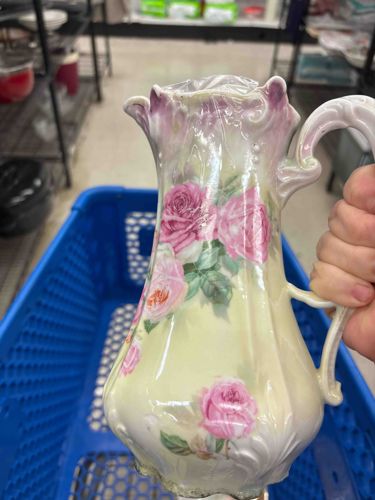
This appears to be a hand-painted porcelain ewer or decorative pitcher, characterized by its elegant form and detailed floral motifs. The item exhibits a base color ranging from a pale yellow or cream, transitioning into blush pinks and mauves towards the ruffled rim. The primary decoration consists of vibrant pink roses with green foliage, seemingly hand-painted, which gives the piece a unique, artistic quality. The painting style suggests a delicate, somewhat impressionistic approach to the roses. Physical characteristics include a gracefully shaped body, widening slightly at the base before tapering upwards to a fluted, decorative rim. A prominent, ornate handle extends from the upper body, adorned with subtle relief work, possibly scrolls or leaves, that matches the aesthetic of the rim's embellishments. There are also raised, pearl-like dots or beads in relief around the neck and body, adding texture and visual interest. The material is clearly porcelain, likely glazed, giving it a shiny, smooth finish. No visible chips, cracks, or repairs are immediately apparent from the provided images, though there appears to be some clear plastic wrapping around the top, potentially for protection. The overall condition seems good, with no obvious signs of significant wear or loss of paint. This type of decorative porcelain, with its detailed painting and classical floral themes, often dates back to the late 19th or early 20th century, consistent with the Rococo Revival or Art Nouveau periods, though without a clearer view of the base or any marks, a precise age is difficult to ascertain. The craftsmanship suggests a moderately high-quality decorative piece, possibly European in origin due to the style of painting and form.
AI Appraisal Report
Upon examining this porcelain ewer, my assessment is that it is a decorative piece produced by Mikasa, a well-known 20th to 21st-century manufacturer of mass-market ceramic and glassware. While the style is reminiscent of late 19th-century European porcelain with its hand-painted roses and ornate, gilded handle, the association with the Mikasa brand firmly places it in a different category. The condition appears to be very good based on the images, with no visible chips or cracks. The hand-painted floral decoration is competently executed, but it lacks the fine detail and artistry of antique European porcelain studios such as Limoges or Royal Worcester, which would command a much higher value. The market for mass-produced decorative porcelain like this is generally driven by decorative appeal rather than rarity or historical importance. Comparable Mikasa pitchers and ewers of a similar style and size typically sell in the secondary market for modest sums. While it is an attractive decorative object, its value is significantly impacted by its modern, mass-market origin. Without a physical inspection, I cannot confirm the specific collection or date of manufacture, nor can I feel for any hidden restorations. However, based on the clearly identifiable style and brand information provided, its identity as a Mikasa product is highly probable, which anchors its value in the contemporary decorative collectibles market.