AI estimate as of July 16, 2025 · verify with a professional before acting
AI-Generated · Verify before acting
Everything on this page is generated by AI for informational purposes only. AI can make mistakes — the AI may misidentify items or misattribute them (artist, maker, brand, designer, origin, era). This is not an official valuation and should not be used for insurance, sale, tax, estate, legal, or lending purposes — or any decision requiring a certified appraisal. It is not an authoritative claim about any person, brand, or rights holder — do not share or rely on it as a factual statement about a third party. Always consult qualified professionals before making financial decisions.
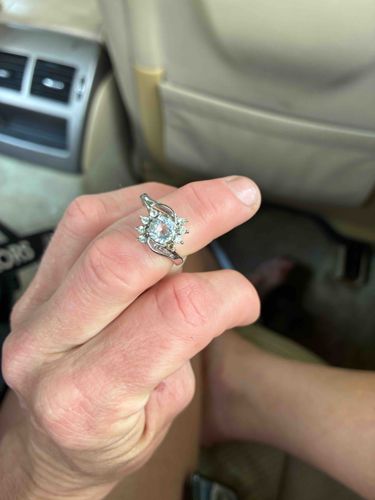
The item is a silver-toned ring, likely made of sterling silver, white gold, or a similar alloy, given its reflective, light-colored appearance. The ring features a pronounced central oval or cushion-cut gemstone surrounded by a cluster of smaller, round brilliant-cut stones. The main stone appears to be a light blue or aquamarine color, suggesting it could be a topaz (likely sky blue or Swiss blue), aquamarine, or even a pale sapphire, though without closer inspection, a definitive identification is difficult. The surrounding smaller stones are colorless and appear to be diamonds or diamond simulants, set in a halo or cluster design that flares outwards, resembling a starburst or floral pattern. The band of the ring splits as it approaches the central setting, creating a graceful, open design that cradles the main stone. There are no visible maker's marks or hallmarks in the provided image, so the manufacturer and precise material composition cannot be definitively identified. The ring appears to be in good condition with no obvious signs of significant wear, damage, or repairs, maintaining its luster. The craftsmanship seems to be of a good standard, indicative of mass-produced or semi-custom jewelry. This style of ring, featuring a central colored gemstone with a diamond halo, has been popular for several decades and does not immediately point to a specific historical period, suggesting it could be contemporary or vintage from the late 20th or early 21st century. Its design is elegant and eye-catching, suitable for everyday wear or special occasions.
AI Appraisal Report
Upon visual examination of the provided image, I assess this silver-toned ring with a blue gemstone and diamond halo to be in good condition, showing no apparent significant wear, damage, or repairs. Its luster is well-maintained, suggesting minimal use or good care. Based purely on the image, authenticity of the materials is challenging to definitively confirm. The central stone appears to be a light blue gemstone, likely topaz or a synthetic equivalent, as a natural aquamarine or sapphire of this size and clarity would typically be set in a higher karat gold. The surrounding colorless stones strongly resemble diamonds due to their brilliance, but without direct testing, they could also be high-quality simulants. The silver tone of the metal suggests sterling silver or white gold. The craftsmanship appears competent, consistent with mass-produced or semi-custom jewelry.
In terms of market conditions, this style of ring, featuring a colored center stone with a diamond halo, is perennially popular, appealing to a broad demographic. The demand for such pieces is steady, driven by their aesthetic appeal and versatility for both everyday wear and special occasions. Rarity is not a significant factor here; comparable rings are widely available across various price points, from fashion jewelry to fine jewelry. Factors significantly impacting value include the precise identification and quality of the central gemstone (natural vs. synthetic, specific type), the diamond content (real vs. simulant, carat weight, clarity, color), and the metal purity (e.g., sterling silver vs. 14k white gold).
Limitations in authenticity verification from images alone are considerable. For full authentication, I would require in-person examination to perform a comprehensive Gemological Institute of America (GIA) 10x magnification inspection of all stones, precise weight measurements, and specific gravity tests for the blue gemstone. Metal purity testing (acid test or XRF) would be crucial to confirm the specific alloy. Provenance documentation, if available, could offer insights into the item's history and original purchase details. Without these physical tests, the exact material composition and thus a definitive valuation remain somewhat speculative.