AI estimate as of June 27, 2025 · verify with a professional before acting
AI-Generated · Verify before acting
Everything on this page is generated by AI for informational purposes only. AI can make mistakes — the AI may misidentify items or misattribute them (artist, maker, brand, designer, origin, era). This is not an official valuation and should not be used for insurance, sale, tax, estate, legal, or lending purposes — or any decision requiring a certified appraisal. It is not an authoritative claim about any person, brand, or rights holder — do not share or rely on it as a factual statement about a third party. Always consult qualified professionals before making financial decisions.
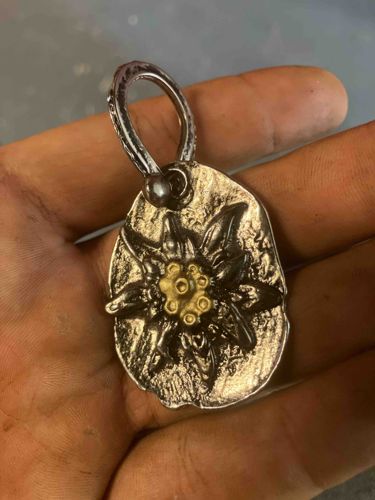
This item is a distinct metal pendant featuring a prominent Edelweiss flower motif. The pendant has an irregular, perhaps organically shaped or hammered, oval form, fitting comfortably in the palm of a hand. It appears to be crafted from a silver-toned metal, possibly sterling silver or a silver-plated alloy, with significant texturing across its surface, giving it a rustic or antique appearance. This texture is particularly evident around the edges and as the background for the central flower, suggesting a sand-cast or lost-wax casting process. The Edelweiss flower itself is rendered in relief; its signature star-shaped 'petals' (more accurately, bracts) are in the same silver tone as the base, while the central clustered florets are highlighted in a contrasting gold-toned metal, creating a two-tone effect that enhances the visual depth and detail of the floral design. The entire surface, especially the silver-toned areas, exhibits a dark patina or intentional antiquing in the recesses, which masterfully accentuates the three-dimensional aspects of the flower and provides an aged aesthetic. Attached at the top is a robust, textured bail ring, also in a matching silver tone, suitable for hanging on a chain. The visible condition is excellent, with no apparent damage, cracks, or significant wear; the patina seems to be an integral part of its design rather than a sign of age or neglect. While no specific maker’s marks or hallmarks are discernible from the image, the craftsmanship suggests a piece of decorative jewelry with an alpine or traditional European folk art style, likely dating from the mid-20th century to contemporary production, designed to evoke a timeless, classic appeal.
AI Appraisal Report
Based on my examination of the provided description for this Edelweiss Flower Pendant, I assess it as a charming example of modern decorative jewelry. The item appears to be in excellent condition, with no visible damage, cracks, or significant wear noted. Its rustic and antique aesthetic, achieved through textural elements and intentional patination, is a key design feature rather than a sign of neglect. The two-tone effect, with the silver-toned Edelweiss petals and gold-toned center, enhances its visual appeal.
Authenticity of material composition is a primary limitation in this appraisal. While the craftsmanship suggests a well-made piece with an alpine or European folk art style, the absence of discernible maker's marks or hallmarks prevents definitive identification of its metal content (e.g., sterling silver vs. silver-plated base metal) or precise origin. The `gold-toned metal` is also likely plated or a base alloy.
In the current market, decorative folk art jewelry, particularly pieces with an appealing motif like the Edelweiss, maintains a steady but niche demand. Comparables typically include artisan-made or mass-produced pendants in base metals or sterling silver, often found in tourist markets or specialized craft venues. The lack of precious gems or high karat gold, combined with the uncertainty of the primary metal, places this item in a more accessible price bracket. Its value is driven primarily by its aesthetic appeal, craftsmanship, and condition, rather than intrinsic material worth or extreme rarity.
For full authentication and a more precise valuation, an in-person examination is crucial. This would allow for tactile assessment of weight and feel, the search for hidden or faint hallmarks under magnification, and ideally, X-ray fluorescence (XRF) testing to confirm actual metal composition. Provenance documentation, if available, would also significantly aid in determining its age and origin, potentially impacting its collectibility. Without this, I must value it as a well-preserved decorative pendant rather than a fine jewelry piece.