AI estimate as of October 25, 2025 · verify with a professional before acting
AI-Generated · Verify before acting
Everything on this page is generated by AI for informational purposes only. AI can make mistakes — the AI may misidentify items or misattribute them (artist, maker, brand, designer, origin, era). This is not an official valuation and should not be used for insurance, sale, tax, estate, legal, or lending purposes — or any decision requiring a certified appraisal. It is not an authoritative claim about any person, brand, or rights holder — do not share or rely on it as a factual statement about a third party. Always consult qualified professionals before making financial decisions.
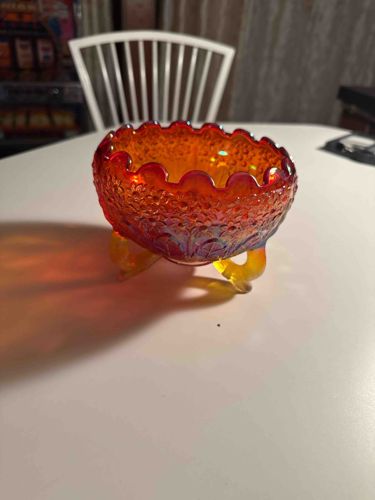
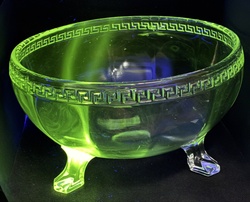
This item is a small, tri-footed bowl or nappy, commonly identified as a toothpick holder or a small candy/nut dish. It is crafted from carnival glass, exhibiting a distinctive iridescent marigold coloration that shimmers with hues of orange, red, gold, and hints of purple/blue depending on the light angle and intensity. The glass itself appears to be pressed rather than blown, a common manufacturing technique for carnival glass, which created the pronounced, textured surface. The exterior of the bowl features a raised, intricate stippled or 'pebbled' pattern, giving it a tactile and visually rich appearance. The rim is scalloped with a wavy, irregular edge, adding to its decorative quality. The bowl is supported by three small, C-scroll or claw-shaped feet that are integral to its design and appear to have been molded with the main body. The overall condition appears to be very good, with no visible chips, cracks, or significant fleabites in the provided images. The iridescence seems strong and well-preserved. While no specific maker's marks are discernible from the image, the style strongly suggests a production period from the early 20th century, specifically the 'Golden Age' of carnival glass (circa 1907-1930s). The craftsmanship, though mass-produced, reflects the decorative aesthetic of the era, focusing on vibrant colors and ornate patterns to mimic more expensive art glass.
AI Appraisal Report
Based on my visual examination of the provided image, this Marigold Carnival Glass Toothpick Holder, or small nappy bowl, appears to be in very good condition. I detect no visible chips, cracks, or significant fleabites, and the marigold iridescence seems strong and well-preserved, consistent with its early 20th-century production. The pressed glass technique, stippled pattern, scalloped rim, and integral tri-footed design are all characteristic features of carnival glass from its 'Golden Age' (circa 1907-1930s).
In terms of market conditions, carnival glass, especially common forms like this toothpick holder, has seen fluctuating demand. While still collectible, the market for these more ubiquitous pieces is generally stable but not experiencing significant appreciation. Comparable sales for similar marigold carnival glass toothpick holders or small nappy bowls in excellent condition typically fall within the $25-$60 range. This piece, while attractive, doesn't present any particularly rare patterns or a renowned maker that would significantly escalate its value. Its demand is driven by collectors of decorative glass, especially those focusing on carnival glass, who appreciate its historical charm and iridescent qualities.
Factors impacting its value positively include its apparent excellent condition and strong iridescence. The lack of any rare features or maker's marks limits its upper value potential.
It is crucial to note the limitations of an appraisal based solely on images. While the visual evidence suggests authenticity and good condition, an in-person examination would be necessary to definitively confirm the absence of hairline cracks, minute fleabites, or internal flaws. Physical inspection would also allow for a more accurate assessment of the glass clarity beneath the iridescence and the true vibrancy of the colors under various lighting conditions. Without provenance documentation or specific maker's marks, full authentication relies on stylistic consistency, which is strong here, but a hands-on review would provide absolute certainty.