AI Appraisal Estimate

AI-generated estimates · not official valuations

From the user

What was submitted

Photo and notes provided by the user — not generated by AI

Submitted item photo
Submitted photo · May 16, 2026

User's notes

16 years old or older

AI analysis below

AI appraisal

AI analysis & estimate

AI-Generated · Verify before acting

Everything below is generated by AI for informational purposes only. AI can make mistakes — the AI may misidentify items or misattribute them (artist, maker, brand, designer, origin, era). This is not an official valuation and should not be used for insurance, sale, tax, estate, legal, or lending purposes — or any decision requiring a certified appraisal. It is not an authoritative claim about any person, brand, or rights holder — do not share or rely on it as a factual statement about a third party. Always consult qualified professionals before making financial decisions.

Note

This analysis also relies on unverified notes provided by the user, which may be incomplete or inaccurate and could affect the result.

Read the full disclaimer

AI Identification

·Not independently authenticated·Verify before acting

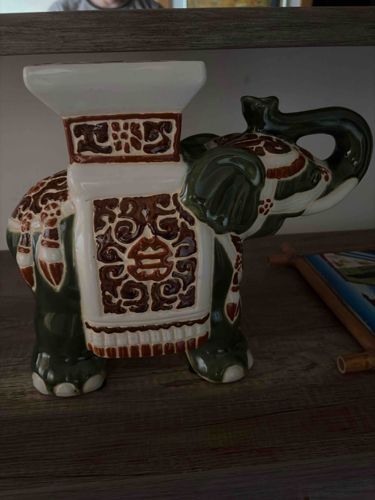
Vintage Chinese-style Ceramic Elephant Garden Stool/Plant Stand

Home Decor / Furniture

AI Estimated Value

·Not an official valuation·Verify before acting

$45.00 - $85.00

As of May 16, 2026

AI Item Analysis

·AI can make mistakes·Verify before acting
This item is a decorative ceramic elephant, designed in the tradition of a Chinese garden stool or plant stand. The piece measures approximately 10 to 14 inches in height and is constructed from glazed stoneware or porcelain. It features a three-color palette consisting of a deep forest green, a creamy off-white base, and reddish-brown (sienna) decorative relief work. The elephant is depicted in a standing position with its trunk raised in a gesture of good luck. It is adorned with an elaborate ceremonial harness and a rectangular Howdah-style flat seat on its back, which is intended for supporting flower pots or small decorative objects. The ornamentation includes geometric fretwork on the seat base, stylized floral motifs on the head, and a large central panel on the side featuring traditional scrollwork. The glaze appears thick and glossy, though there are visible signs of age consistent with the provided 16-year minimum, including minor surface dust in recessed areas and slight variations in the pigment saturation. The overall craftsmanship suggests a mass-produced decorative piece, likely from the late 20th century or early 2000s, designed to mimic Ming or Qing dynasty garden furniture styles. No visible cracks or major chips are apparent in the image, indicating it has been well-maintained as an indoor decorative element.
AI Appraisal Report

·AI can make mistakes·Verify before acting
I have examined the digital representation of the ceramic elephant garden stool. Based on the tricolor glaze—forest green, off-white, and sienna—this piece is a mid-to-late 20th-century decorative item produced to satisfy the Western market's demand for 'Chinoiserie' accents. While the owner dates it to at least 16 years old, the styling and manufacturing techniques are characteristic of mass-produced exports from the 1980s through the early 2000s. The condition appears Excellent (EX) with no visible crazing, chips, or fractures. The raised trunk is a desirable feature in Feng Shui-inspired decor, symbolizing good luck, which maintains its appeal in the secondary market. However, the lack of artisanal irregularity and the uniform application of the glaze suggest this is not an antique of the Ming or Qing dynasties, which would command thousands of dollars. Market demand for such stools is steady but saturated. Comparables on platforms like eBay and Etsy show similar mass-market ceramic elephants consistently selling in the $50-$75 range. Higher values are reserved only for larger 20-inch models or those with verified designer marks. Limitations: This appraisal is based solely on visual inspection of images. I cannot confirm the presence of a maker's mark on the base, nor can I verify the ceramic's density or sound resonance, which helps distinguish between high-fired porcelain and lower-quality earthenware. A physical inspection would be required to rule out professionally repaired cracks or cold-painted touch-ups that are not visible in photographs.

Get your items appraised

Instant estimates of your treasures with AI-powered appraisals

Browse More Appraisals