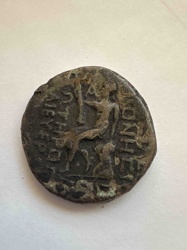
Alexander the Great Silver Tetradrachm Reverse
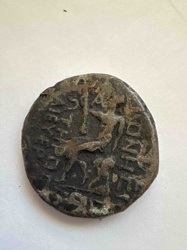
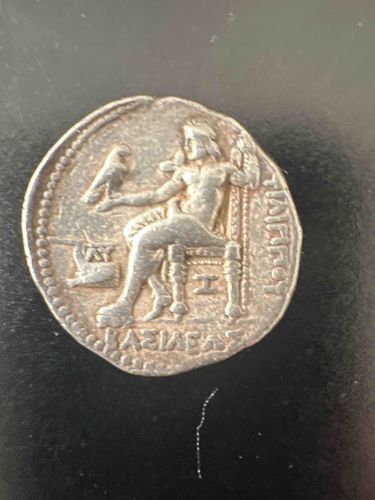
This is a silver Greek coin, specifically the reverse side of a Tetradrachm minted during or shortly after the reign of Alexander III of Macedon (336–323 BC). The coin features a high-relief depiction of Zeus seated on a backless throne, facing left, holding an eagle in his outstretched right hand and a long scepter in his left. The figure of Zeus is muscular and detailed, showcasing classical Greek Hellenistic artistry. To the right, the Greek inscription 'AΙΓΕΙΔΑΙ' (or similar local variant) is visible, with 'ΒΑΣΙΛΕΩΣ' (Basileos, meaning King) appearing in the exergue below. There is a visible control mark beneath the throne, appearing like the letter 'T' or a monogram, and another symbol (possibly a plow or torch) in the left field, which are used by numismatists to identify the specific mint of origin, such as Babylon, Amphipolis, or Sidon. The coin has a circular shape with an irregular, slightly hammered edge and a beaded border. The silver exhibits a dark grey patina with bits of luster remaining in protected areas. Condition-wise, it shows moderate circulation wear on the high points of Zeus's torso and knee; however, the strike is well-centered with clear topographical details. There is a slight flan crack visible on the upper left edge, which is common for ancient hand-struck coinage.
AI-Generated Appraisal Disclaimer
Estimated Value
$800 - $1,200
Basic Information
Category
Ancient Numismatics / Greek Coins
Appraised On
March 5, 2026
Estimated Value
$800 - $1,200
Item Description
This is a silver Greek coin, specifically the reverse side of a Tetradrachm minted during or shortly after the reign of Alexander III of Macedon (336–323 BC). The coin features a high-relief depiction of Zeus seated on a backless throne, facing left, holding an eagle in his outstretched right hand and a long scepter in his left. The figure of Zeus is muscular and detailed, showcasing classical Greek Hellenistic artistry. To the right, the Greek inscription 'AΙΓΕΙΔΑΙ' (or similar local variant) is visible, with 'ΒΑΣΙΛΕΩΣ' (Basileos, meaning King) appearing in the exergue below. There is a visible control mark beneath the throne, appearing like the letter 'T' or a monogram, and another symbol (possibly a plow or torch) in the left field, which are used by numismatists to identify the specific mint of origin, such as Babylon, Amphipolis, or Sidon. The coin has a circular shape with an irregular, slightly hammered edge and a beaded border. The silver exhibits a dark grey patina with bits of luster remaining in protected areas. Condition-wise, it shows moderate circulation wear on the high points of Zeus's torso and knee; however, the strike is well-centered with clear topographical details. There is a slight flan crack visible on the upper left edge, which is common for ancient hand-struck coinage.
Get Your Items Appraised
Instant estimates of your treasures with AI-powered instant appraisals