These notes were written by the person who submitted this item. Appraiser.AI has not verified them, and the AI's identification and estimate may rely on them.
AI Estimated Value
Not an official valuation
$15-30
AI estimate as of September 15, 2025 · verify with a professional before acting
AI-Generated · Verify before acting
Everything on this page is generated by AI for informational purposes only. AI can make mistakes — the AI may misidentify items or misattribute them (artist, maker, brand, designer, origin, era). This is not an official valuation and should not be used for insurance, sale, tax, estate, legal, or lending purposes — or any decision requiring a certified appraisal. It is not an authoritative claim about any person, brand, or rights holder — do not share or rely on it as a factual statement about a third party. Always consult qualified professionals before making financial decisions.
This analysis also relies on unverified notes provided by the user, which may be incomplete or inaccurate and could affect the result.
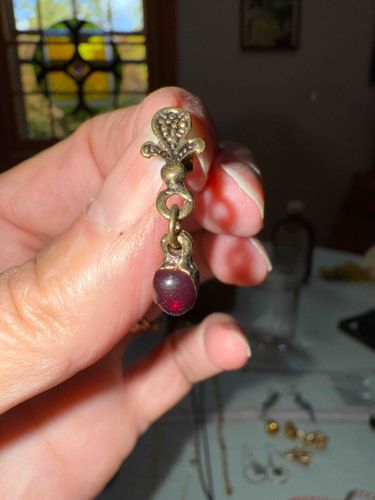
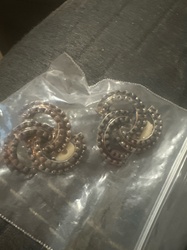
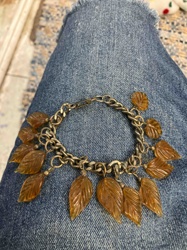
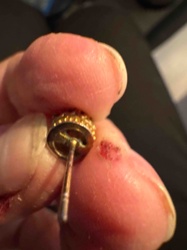
This item is a single clip-on earring featuring an antique-inspired design. The main body of the earring appears to be constructed from a brass or bronze-toned metal, showing a rich, aged patina consistent with older pieces. The top portion of the earring, which serves as the clip mechanism, is adorned with an ornate, stylized floral or Fleru-de-lis motif, textured with tiny raised dots or granulation, signaling a decorative and perhaps Victorian or Edwardian aesthetic influence. Below this clip, a short chain link connects to a teardrop or oval-shaped bezel-set red cabochon. The cabochon exhibits a deep, translucent ruby-red color with a smooth, polished surface, and some subtle internal characteristics or inclusions can be glimpsed, suggesting it might be a glass or a less precious gemstone like garnet or aventurine glass. The metal setting around the cabochon is simple, yet securely holds the stone. There are visible signs of wear, including darkening and some minor surface abrasions on the metal, indicative of age and use, but no significant damage like cracks or breaks. The overall craftsmanship appears to be commercial grade, common for costume jewelry of an earlier era. The clip mechanism is visible from the back, and while not fully detailed, it seems to be a standard spring-loaded clip, functioning to secure the earring without piercing. The item’s style suggests a mid-20th century or earlier period, possibly 1940s-1970s, though its design harks back to earlier art nouveau or revival styles. No specific maker's marks or signatures are discernible from the provided image.
AI Appraisal Report
I have examined the Vintage-Style Clip-On Earring with Red Cabochon. Based on visual assessment, this appears to be a single, antique-inspired clip-on earring. The metal, likely brass or bronze-toned, exhibits an aged patina consistent with older costume jewelry. The ornate floral/Fleur-de-lis motif on the clip suggests a Victorian or Edwardian revival style, possibly dating this piece to the mid-20th century (1940s-1970s), but its design cues predate that. The red cabochon is most likely glass or a less precious gemstone such as garnet, set securely in a simple bezel. The visible wear, darkening, and minor surface abrasions on the metal are indicative of age and use, but there is no significant damage like cracks or breaks, suggesting good overall condition for its presumed age as a costume piece. The craftsmanship appears to be commercial grade, typical for costume jewelry of its era.
Considering current market conditions for vintage costume jewelry, similar single earrings or pairs of this quality and style typically fetch modest prices. Factors impacting value include the fact that it is a single earring, which reduces its desirability compared to a pair. While the design is aesthetically pleasing, it does not appear to be from a highly sought-after designer or manufacturer, as no maker's marks are discernible. The cabochon, being likely glass, also keeps the value in the costume jewelry range. Demand for single vintage clip-on earrings is limited.
For full authentication and a more precise material identification, an in-person examination would be critical. This would allow for a closer inspection of the cabochon to determine if it is glass, garnet, or another material, and to search for any faint maker's marks or stamps. Scientific testing on the metal composition and the cabochon's refractive index or specific gravity could provide definitive answers regarding materials. Provenance documentation, though unlikely for an item of this type, would also be beneficial but is not available here. Without these, my appraisal is based on its visual characteristics as a vintage costume piece.