AI Appraisal Estimate

AI-generated estimates · not official valuations

From the user

What was submitted

Photo and notes provided by the user — not generated by AI

Submitted item photo
Submitted photo · June 27, 2026

User's notes

No additional notes provided.

AI analysis below

AI appraisal

AI analysis & estimate

AI-Generated · Verify before acting

Everything below is generated by AI for informational purposes only. AI can make mistakes — the AI may misidentify items or misattribute them (artist, maker, brand, designer, origin, era). This is not an official valuation and should not be used for insurance, sale, tax, estate, legal, or lending purposes — or any decision requiring a certified appraisal. It is not an authoritative claim about any person, brand, or rights holder — do not share or rely on it as a factual statement about a third party. Always consult qualified professionals before making financial decisions.

Read the full disclaimer

AI Identification

·Not independently authenticated·Verify before acting

Late 19th or Early 20th Century Tonalist Landscape Painting

Fine Art - Painting

AI Estimated Value

·Not an official valuation·Verify before acting

$1,400 - $2,200

As of June 27, 2026

AI Item Analysis

·AI can make mistakes·Verify before acting
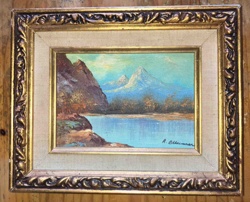
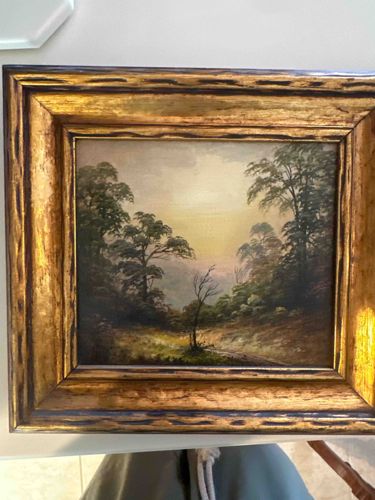
This is a small-scale original oil painting on board or canvas, depicting a serene woodland landscape at dawn or dusk. The work is executed in the Tonalist style, characterized by a soft, diffused light and a limited palette of greens, browns, and hazy ambers. The composition features a central clearing or path flanked by mature, finely detailed deciduous trees with a single thin, bare sapling positioned as a focal point in the middle ground. The background is dominated by a luminous, atmospheric sky that suggests a low-hanging sun obscured by mist. The brushwork is delicate and controlled, particularly in the rendering of foliage and the transition of light in the sky. The painting is housed in a substantial, high-quality cove-profile wooden frame with a distressed gold leaf or gilt finish, featuring dark rhythmic worm-hole or chiseled decorative accents along the outer and inner edges. The frame shows some minor gesso cracking and light oxidation consistent with age, but remains structurally sound. While no signature is immediately visible in the provided image, the craftsmanship suggests a late Victorian or early Edwardian era production, likely circa 1890-1920. The overall condition appears excellent with a naturally aged varnish that depth and a warm golden glow to the piece.


AI Appraisal Report

·AI can make mistakes·Verify before acting
Upon visual examination of this Tonalist landscape, I find it to be a compelling example of early 20th-century American or European atmospheric painting. The work demonstrates high technical proficiency, particularly in the 'sfumato' transition of the horizon and the delicate impasto used for the central sapling. The palette is typical of the George Inness or Barbizon influence prevalent between 1890 and 1915. The frame is a notable asset; the cove-profile gilded wood is a period-authentic 'Newcomb-Macklin' style, which separately holds significant value for collectors. The condition appears stable, though the naturally aged varnish has likely ‘yellowed,’ which in this case enhances the Tonalist ‘golden hour’ effect. In the current market, small-scale Tonalist works maintain a steady demand among interior designers and private collectors seeking the 'old world' aesthetic. Comparables for unsigned works of this quality typically reach $1,200 to $1,800, while the superior frame adds a premium. However, the lack of a visible signature limits the value to its decorative and period merit rather than an attributed artist’s market. My assessment is limited by the digital format; I cannot verify the substrate (canvas vs. board) or check for overpainting without a UV blacklight. A physical inspection is required to check for signatures under the frame’s edge and to assess the craquelure pattern under magnification. Full authentication would require provenance documentation or a forensic analysis of the pigments to confirm they pre-date synthetic developments of the mid-20th century.

Get your items appraised

Instant estimates of your treasures with AI-powered appraisals

Browse More Appraisals