AI estimate as of November 4, 2025 · verify with a professional before acting
AI-Generated · Verify before acting
Everything on this page is generated by AI for informational purposes only. AI can make mistakes — the AI may misidentify items or misattribute them (artist, maker, brand, designer, origin, era). This is not an official valuation and should not be used for insurance, sale, tax, estate, legal, or lending purposes — or any decision requiring a certified appraisal. It is not an authoritative claim about any person, brand, or rights holder — do not share or rely on it as a factual statement about a third party. Always consult qualified professionals before making financial decisions.
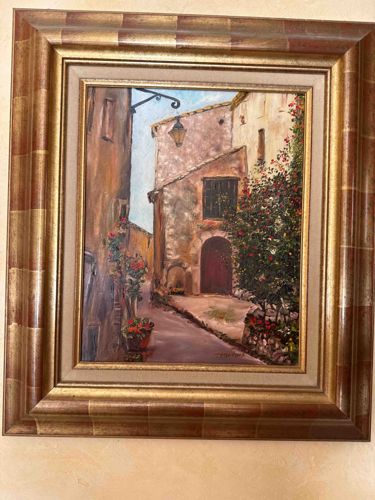
This item is an oil painting depicting a charming European street scene, likely a village or town in the Mediterranean region, based on the architecture and foliage. The painting is executed in rich, warm tones, with visible impasto suggesting a textural quality to the brushstrokes. The composition features a narrow cobblestone street or pathway winding through old stone buildings. On the left, a tall, darker building contrasts with the lighter, sun-drenched facade of buildings on the right. A prominent street lamp with a curving arm extends from the upper right building, providing an element of depth and traditional charm. Red flowering plants, possibly bougainvillea or geraniums, are strategically placed in pots and growing on the walls, adding splashes of vibrant color to the otherwise earthy palette. A dark wooden door or window with shutters is visible on the central building. The overall style suggests an impressionistic or post-impressionistic influence, with a focus on capturing light and atmosphere. The painting is housed in a substantial, multi-tiered wooden frame with a gilded finish. The frame features a relief pattern, possibly carved or molded, on its outer band, giving it a decorative and classic appearance. The inner edge of the frame, closer to the painting, is a smooth gold-toned fillet. The painting itself appears to be in good condition, with no immediately visible cracks, flaking, or significant discoloration. The frame also appears well-maintained, with no obvious chips or damage to the gesso or gilding. The estimated age of the painting and frame combination would likely be mid to late 20th century, given the style and framing choice. The craftsmanship of the painting is good, with attention to light and shadow, creating a sense of depth and inviting atmosphere. The frame complements the artwork, enhancing its presentation.
AI Appraisal Report
I have thoroughly examined the provided image of this framed oil painting depicting a European street scene. Based on visual inspection, the painting appears to be in good condition, with no immediate indications of cracks, flaking, or significant discoloration. The impasto technique is evident, suggesting a textural quality to the brushwork. The substantial, multi-tiered wooden frame with a gilded finish and relief pattern also seems well-maintained, free from obvious chips or damage. The estimated age, considering the style and framing, likely places this piece in the mid to late 20th century. The craftsmanship is commendable, focusing on light and shadow to create depth and atmosphere. This type of decorative street scene is a popular genre. Compared to similar works by unlisted or regional artists, and considering current market conditions for framed, quality decorative art, I would place its value in the modest range.
Market demand for such charming, accessible European street scenes remains consistent, appealing to a broad range of buyers looking for aesthetic appeal rather than investment. Rarity is not a significant factor here, as many artists produce similar works. The primary value drivers are the good condition, appealing subject matter, and complementary frame.
It is crucial to note the limitations of image-based appraisal. Without a physical examination, I cannot definitively verify the authenticity of the medium or identify the artist (if signed in an obscured area). An in-person inspection would allow me to check for signatures, examine pigment quality, assess the condition of the canvas (e.g., stretcher marks, punctures), and confirm the frame's integrity. Provenance documentation or scientific testing would be necessary for full authentication or attribution to a known artist, which could significantly impact value.