AI Appraisal Estimate

AI-generated estimates · not official valuations

From the user

What was submitted

Photo and notes provided by the user — not generated by AI

Submitted item photo
Submitted photo · May 16, 2026

User's notes

No additional notes provided.

AI analysis below

AI appraisal

AI analysis & estimate

AI-Generated · Verify before acting

Everything below is generated by AI for informational purposes only. AI can make mistakes — the AI may misidentify items or misattribute them (artist, maker, brand, designer, origin, era). This is not an official valuation and should not be used for insurance, sale, tax, estate, legal, or lending purposes — or any decision requiring a certified appraisal. It is not an authoritative claim about any person, brand, or rights holder — do not share or rely on it as a factual statement about a third party. Always consult qualified professionals before making financial decisions.

Read the full disclaimer

AI Identification

·Not independently authenticated·Verify before acting

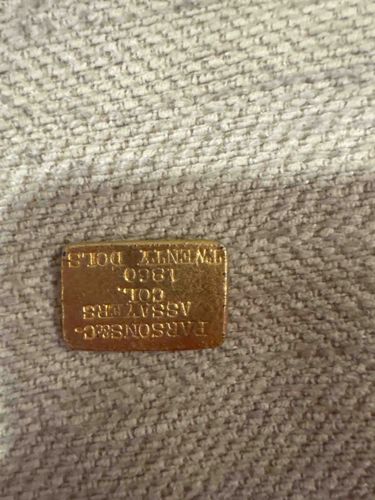
Parsons & Co. 1860 Assayers Twenty Dollars Gold Bar (Ingot)

Numismatics / Historical Currency / Bullion

AI Estimated Value

·Not an official valuation·Verify before acting

$50 - $25,000

As of May 16, 2026

AI Item Analysis

·AI can make mistakes·Verify before acting
This item is a small, rectangular gold-colored ingot or bar, presenting as a specimen of private territorial gold from the Colorado gold rush era. The face of the bar features a stamped inscription in serif lettering arranged in five lines: 'PARSONS & Co.', 'ASSAYERS', 'COL.', '1860', and 'TWENTY DOLS.' (note the inverted orientation of the text in the image). The bar is fashioned with rounded corners and a slightly uneven surface consistent with hand-poured or hand-stamped manufacturing techniques of the mid-19th century. In terms of condition, the piece shows significant surface wear, including numerous small nicks, scratches, and pitting across the face and edges. There is a visible patina or localized discoloration, particularly around the recessed areas of the letters, which suggests aging or long-term handling. The metal has a deep yellow hue characteristic of high-purity gold or a gold-plated replica. While Parsons & Co. were historical assayers in Tarryall, Colorado, authentic specimens are extremely rare; many such bars found today are commemorative re-strikes, replicas, or souvenirs. A material analysis (such as X-ray fluorescence) and weight measurement would be necessary to distinguish if this is a solid precious metal historical artifact or a plated modern reproduction. The craftsmanship is utilitarian, reflecting the frontier origins of the original mark.

AI Appraisal Report

·AI can make mistakes·Verify before acting
I have carefully examined the Parsons & Co. 1860 Assayers Twenty Dollars Gold Bar via the provided imagery. The piece exhibits the characteristic serifed stamping and utilitarian geometry associated with the Tarryall, Colorado assayers. Visually, the ingot shows significant surface abrasions, displacement of metal consistent with soft alloys (such as high-karat gold or lead-based replicas), and an aged patina. However, a significant valuation gap exists based on authenticity. Genuine Parsons & Co. ingots are among the rarest artifacts of American private territorial gold; fewer than a handful of authentic gold specimens are known to exist. If confirmed as a genuine 19th-century gold artifact, the value would likely exceed $25,000, depending on gold content and historical provenance. Conversely, the market is saturated with mid-20th-century brass or gold-plated 'souvenir' re-strikes, typically valued between $50 and $150 as curiosities. The 'inverted' text and the specific texture of the pitting suggest this may be a cast replica rather than a struck original. Because images cannot determine specific gravity, metallic composition, or the presence of casting bubbles versus genuine flow lines, I cannot certify authenticity. A final appraisal requires X-ray fluorescence (XRF) testing to determine the exact fineness of the gold and a weight check against historical records. Provenance documentation tracing the item back to the 19th century would also be essential for a high-value determination. Until such tests are performed by a firm like NGC or PCGS, it should be treated as a decorative specimen.

Get your items appraised

Instant estimates of your treasures with AI-powered appraisals

Browse More Appraisals