AI estimate as of October 6, 2025 · verify with a professional before acting
AI-Generated · Verify before acting
Everything on this page is generated by AI for informational purposes only. AI can make mistakes — the AI may misidentify items or misattribute them (artist, maker, brand, designer, origin, era). This is not an official valuation and should not be used for insurance, sale, tax, estate, legal, or lending purposes — or any decision requiring a certified appraisal. It is not an authoritative claim about any person, brand, or rights holder — do not share or rely on it as a factual statement about a third party. Always consult qualified professionals before making financial decisions.
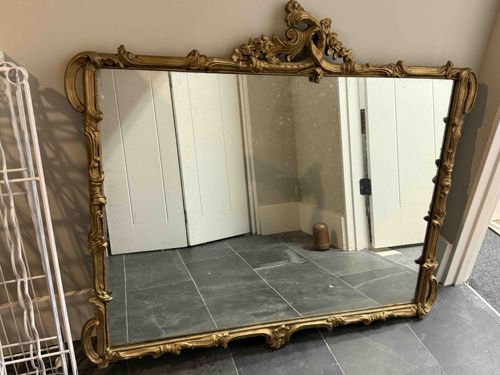
This is a large, rectangular wall mirror featuring an ornately carved and gilded frame, indicative of a Rococo or Rococo Revival style. The frame appears to be constructed from wood, likely pine or a similar soft wood, which has been carved and then finished with a gold-colored gesso and gilding, possibly gold leaf or a metallic paint. Its overall dimensions suggest it is a statement piece, suitable for a large entryway, living room, or bedroom.
The most prominent features are the intricate carvings, particularly at the top and corners. The crest at the top center is elaborate, showcasing scrolling acanthus leaves, C-scrolls, and floral motifs typical of the Rococo aesthetic, creating an asymmetrical yet balanced design. Similar decorative elements are present in the corners and along the frame's edges, albeit in a more subdued manner. The frame itself has a complex profile with molded edges and recessed panels, some of which appear to have a beaded or reeded texture.
Observable condition issues include areas of wear to the gilding, particularly along the raised elements of the carving and edges, revealing a darker underlayer, which could be the gesso or the wood itself. There are also some potential scuff marks on the mirror glass, visible as lighter smudges and imperfections in the reflection. Given the style and visible patina, the mirror likely dates from the late 19th to mid-20th century, possibly a vintage piece from the Rococo Revival period. The quality of craftsmanship appears to be good, with detailed carving, suggesting it was a mass-produced item designed to mimic antique luxury, yet still well-made.
AI Appraisal Report
Upon examining the images provided, I have assessed this large, Rococo Revival style wall mirror. The frame, likely carved wood with a gesso and gilded finish, exhibits elaborate C-scrolls and acanthus leaf motifs characteristic of the late 19th or early 20th century. The craftsmanship appears to be of good quality for a reproduction piece, intended to emulate the opulence of the 18th-century French Rococo period. Condition-wise, the mirror shows age-appropriate wear, including losses and rubbing to the gilding on raised areas, revealing the darker underlayer. Some minor scuffs are also visible on the mirror glass. These are not significant detractors for a vintage piece and contribute to its decorative patina.
The market for such decorative mirrors is fairly consistent. While not a period antique, its large size and ornate style make it a desirable statement piece for interior design. Comparables from the Rococo Revival period, with similar dimensions and condition, typically sell in the $400 to $600 range at auction and in retail settings. The value is driven primarily by its decorative appeal rather than rarity or historical significance.
It is important to note that this appraisal is based solely on visual information from images. A definitive assessment of the materials (e.g., confirming if it is gold leaf vs. metallic paint), the type of wood, and the exact age would require in-person examination. Verifying if it is a true 18th-century antique, which would dramatically increase its value, would necessitate a physical inspection of construction techniques (e.g., tool marks, joinery) and potentially material analysis. Without provenance or physical access, I am appraising it as a high-quality vintage reproduction.