AI estimate as of October 12, 2025 · verify with a professional before acting
AI-Generated · Verify before acting
Everything on this page is generated by AI for informational purposes only. AI can make mistakes — the AI may misidentify items or misattribute them (artist, maker, brand, designer, origin, era). This is not an official valuation and should not be used for insurance, sale, tax, estate, legal, or lending purposes — or any decision requiring a certified appraisal. It is not an authoritative claim about any person, brand, or rights holder — do not share or rely on it as a factual statement about a third party. Always consult qualified professionals before making financial decisions.
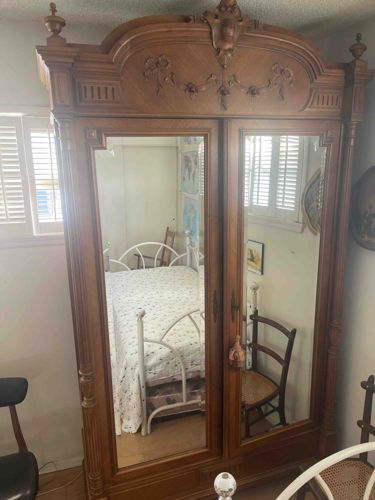
This is a large, ornate wardrobe, likely originating from the Victorian era. It features a robust wooden construction, possibly oak or walnut, given its rich, medium-brown tone and visible grain patterns. The wardrobe is characterized by two full-length mirrored doors that serve as the main front access. The mirrors appear to be original or period-appropriate, framed by solid wood. Above the mirrored doors, there is an intricately carved pediment, showcasing classical or naturalistic motifs, including a prominent central cartouche or shell-like carving flanked by scrolled foliage and stylized floral garlands. The top corners of the wardrobe are adorned with turned finials, adding to its architectural presence. On either side of the mirrored doors, there are fluted pilasters or columns, contributing to its grand and formal appearance. The overall condition appears to be good for its age, displaying a natural patina consistent with antique furniture. Minor surface wear, scuffs, or small imperfections might be present but are not distinctly visible without closer inspection. The craftsmanship indicates a high-quality piece, with attention to detail in the carving and construction, suggesting it was a significant piece of furniture in its original setting. The style points strongly to late 19th-century design.
AI Appraisal Report
Upon visual examination of the provided image, I assess this Victorian-era mirrored wardrobe to be a high-quality example of late 19th-century design. The robust construction, likely of oak or walnut, combined with the ornate carving – including the prominent pediment with naturalistic motifs, scrolled foliage, and turned finials – firmly supports its authenticity as a period piece. The full-length mirrored doors and fluted pilasters contribute to its architectural grandeur. Condition appears good for its age, exhibiting a natural patina consistent with antique furniture. I observe no major damage or repairs from the image, only typical minor surface wear, which is expected. However, determining the originality of the mirrors definitively would require in-person inspection for plate quality and silvering characteristics.
Market conditions for substantial Victorian furniture are steady, with well-preserved, ornate pieces like this maintaining strong appeal among collectors and those furnishing period homes. Comparables in this condition and style typically fetch between $1,800 and $2,500, depending on wood type, internal fittings (not visible here), and regional demand. The detailed craftsmanship and architectural presence suggest a higher-end piece for its era, which positively impacts its value. While not exceedingly rare, pieces of this scale and decorative quality are less common than simpler Victorian items.
Limitations of this appraisal rest solely on visual assessment of an image. I cannot verify the type of wood definitively without physical examination (e.g., grain, weight, internal structure). Similarly, internal condition (shelves, hanging space, drawer function if any) and any hidden repairs or structural weaknesses cannot be determined. Full authentication, especially of wood type and originality of internal components, would require in-person inspection, and ideally, some provenance documentation would further enhance value and confirm history.