AI estimate as of August 25, 2025 · verify with a professional before acting
AI-Generated · Verify before acting
Everything on this page is generated by AI for informational purposes only. AI can make mistakes — the AI may misidentify items or misattribute them (artist, maker, brand, designer, origin, era). This is not an official valuation and should not be used for insurance, sale, tax, estate, legal, or lending purposes — or any decision requiring a certified appraisal. It is not an authoritative claim about any person, brand, or rights holder — do not share or rely on it as a factual statement about a third party. Always consult qualified professionals before making financial decisions.
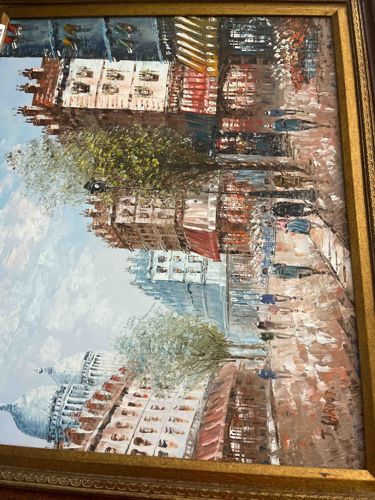
This is an oil painting on canvas depicting a bustling European city street scene, likely Paris, given the notable dome structure in the background which strongly resembles the Sacré-Cœur Basilica or another similar landmark. The painting is characterized by its impasto technique, where thick layers of paint are applied to the canvas, creating a textured surface that is visible to the naked eye. The colors are vibrant, featuring warm tones of terracotta, brown, and red for the buildings, contrasted with cooler blues and grays for the sky and distant architecture. Green foliage from trees adds pops of natural color. The street is populated with stylized figures, adding a sense of movement and life to the scene. These figures are rendered with minimal detail, suggested rather than explicitly drawn, consistent with a more impressionistic or expressionistic style. The overall composition is dynamic, leading the eye down the street. The painting is housed within a traditional ornate gold-colored frame, which appears to be made of wood or a composite material with decorative moldings. The frame shows some signs of wear, consistent with age, such as minor scuffs or chips, but it generally complements the artwork. There is a visible signature in the lower right corner, which appears to read 'J. SARDO', indicating the artist's identity. The condition of the painting itself appears good, with no obvious major damage, tears, or significant paint loss. The texture of the impasto gives it a rich, three-dimensional quality. Based on the style and discernible details, it likely dates from the mid to late 20th century. The craftsmanship indicates a competent artist, with a focus on capturing atmosphere and light through texture and color.
AI Appraisal Report
Upon visual examination of the provided image, I assess this Impasto Oil Painting of a European Cityscape by J. Sardo to be in good overall condition. The impasto appears intact, and there are no immediately discernible tears, significant paint loss, or major blemishes on the canvas. The ornate gold-colored frame shows consistent minor wear, scuffs, or chips, which is typical for its presumed age and does not significantly detract from the piece. The signature 'J. SARDO' is clearly visible in the lower right corner, lending credence to the artist's identity.
Regarding authenticity, my assessment is based solely on visual cues from the image. Without an in-person examination, I cannot definitively verify the painting's originality, the authenticity of the signature, or the materials used. A full authentication would require physical inspection to assess brushwork, paint layering, and canvas type, alongside provenance documentation (e.g., bills of sale, exhibition history) to establish a clear chain of ownership. Scientific testing, such as pigment analysis or UV light examination, could further confirm the age and composition of the materials.
In terms of market conditions, paintings by “J. Sardo” (common name, potentially a commercial artist) generally fall into the decorative art category, rather than fine art with established auction records for specific artists. While the impasto technique and vibrant imagery are appealing, demand for such works is typically driven by aesthetic preference and suitability for interior decor. Rarity is not a significant factor here; similar cityscapes by various artists are relatively common. The value is primarily influenced by its decorative appeal, condition, and marketability for a broad audience rather than collectibility based on artist fame. Comparative sales for similar decorative European cityscapes by lesser-known artists in this size and condition typically range for hundreds of dollars.