AI estimate as of October 19, 2025 · verify with a professional before acting
AI-Generated · Verify before acting
Everything on this page is generated by AI for informational purposes only. AI can make mistakes — the AI may misidentify items or misattribute them (artist, maker, brand, designer, origin, era). This is not an official valuation and should not be used for insurance, sale, tax, estate, legal, or lending purposes — or any decision requiring a certified appraisal. It is not an authoritative claim about any person, brand, or rights holder — do not share or rely on it as a factual statement about a third party. Always consult qualified professionals before making financial decisions.
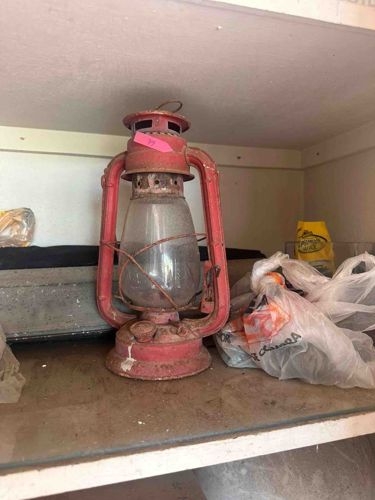
This is a vintage kerosene lantern, characterized by its traditional 'barn lantern' or 'hurricane lamp' design. The predominant color is a faded, weathered red, suggesting a significant age and exposure to elements. It is constructed primarily of metal, likely steel or tin, with a clear glass globe enclosing the wick mechanism. The lantern features a handle on top for carrying or hanging, and two vertical metal bars ('guards' or 'bail arms') extending from the top cap to the base, which protect the glass globe. The base is wider and circular, housing the fuel tank. Numerous visible condition issues include significant paint loss, especially around the base and lower sections of the guards, revealing rusted metal underneath. The metal surfaces display a heavy patina, consistent with outdoor use or storage in a non-climate-controlled environment. The glass globe appears intact but is heavily covered in grime, dust, and possibly soot on the interior and exterior, obscuring clarity. There's a white, possibly adhesive or paint stain, on the lower part of the base. A small pink adhesive tag with '27' written on it is affixed to the top portion of the lantern. The overall impression is one of a utilitarian object that has seen considerable use and wear, likely dating from the mid-20th century or earlier. No specific manufacturer's marks or signatures are discernible from the provided images, but the robust construction and design indicate a functional, durable item typical of its kind.
AI Appraisal Report
I have visually examined this vintage red kerosene lantern based on the provided image. The item presents as a classic 'barn lantern' or 'hurricane lamp' design, constructed of metal with a clear glass globe. Its faded red paint, significant paint loss, exposed rust, and heavy patina strongly indicate considerable age and extensive use, consistent with a mid-20th-century or earlier utilitarian object. The glass globe appears intact but is heavily soiled. The white stain and the pink '27' tag suggest it may have been from an estate sale or antique booth.
In terms of condition, it's fair to poor. While the structural integrity seems maintained, the aesthetic degradation from rust, paint loss, and grime is substantial. This condition severely impacts its value as a display piece without restoration. Authenticity, based purely on visual cues, is probable for its age and type, aligning with typical mass-produced kerosene lanterns from that era. However, without manufacturer's marks, definitive authentication of origin or specific model is impossible from images alone.
Market conditions for such items are generally stable but not highly lucrative. Similar heavily worn, unrestored kerosene lanterns typically sell in the $20-50 range, often at antique markets, flea markets, or online through platforms like eBay. Comparables in better condition or with notable manufacturer markings might fetch more. This lantern's demand is primarily from decorators seeking rustic charm, collectors of vintage utilitarian objects, or those looking for a restoration project. It is not particularly rare; thousands of similar lamps were produced. The lack of discernible manufacturer's marks prevents it from commanding a premium.
Factors significantly impacting value here are its heavily weathered condition and the absence of any identifying maker's marks. A thorough physical inspection would be necessary to assess the functionality of the wick mechanism, examine the internal condition for severe corrosion or structural weakness, and properly clean the globe to check for etching or damage. Provenance documentation would be required for any historical significance. Scientific testing, like metal analysis or paint spectrometry, is generally unwarranted for an item of this value unless there's a specific, unsubstantiated claim of rarity or origin.