AI estimate as of September 30, 2025 · verify with a professional before acting
AI-Generated · Verify before acting
Everything on this page is generated by AI for informational purposes only. AI can make mistakes — the AI may misidentify items or misattribute them (artist, maker, brand, designer, origin, era). This is not an official valuation and should not be used for insurance, sale, tax, estate, legal, or lending purposes — or any decision requiring a certified appraisal. It is not an authoritative claim about any person, brand, or rights holder — do not share or rely on it as a factual statement about a third party. Always consult qualified professionals before making financial decisions.
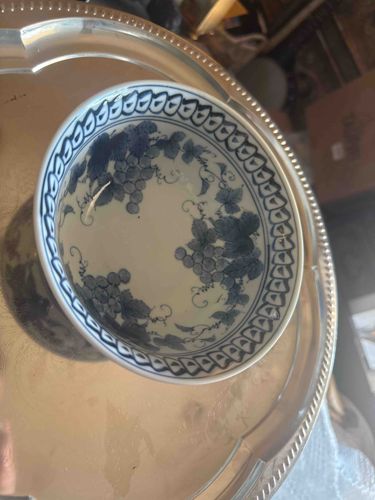
This item is a circular porcelain bowl, primarily white with intricate blue underglaze decoration. The interior of the bowl features a prominent design of grape clusters and intertwining grapevines with leaves, covering the central portion of the dish. The blue color used for the grapes and foliage appears to be a medium to dark cobalt blue, exhibiting some variation in intensity that adds depth to the design. A decorative border encircles the rim of the bowl's interior, consisting of a repeated pattern of stylized shapes, possibly inspired by Ruyi or Greek key motifs, framed by thin blue lines. The exterior of the bowl is not visible in the provided image. The edges of the bowl appear smooth and refined, indicating good craftsmanship. There are no obvious chips, cracks, or significant abrasions visible, suggesting the bowl is in good to very good condition. The porcelain has a glossy finish, typical of glazed ceramics. The style suggests it could be East Asian, possibly Chinese or Japanese, and potentially mid-20th century or earlier, given the traditional artistry. The bowl is currently resting on a reflective, possibly silver-plated or stainless steel, serving tray with a beaded edge, which is not part of the item being appraised.
AI Appraisal Report
Based on my visual examination of the provided image, this blue and white porcelain bowl presents a traditional aesthetic, likely East Asian. The intricate grape cluster and grapevine motif, executed in a varied cobalt blue underglaze, demonstrates a good level of artistic skill. The decorative border on the interior rim further enhances its appeal. The condition appears to be very good; I observe no obvious chips, cracks, or significant abrasions on the visible surfaces, and the glossy glaze is intact. This suggests careful handling over its lifetime.
Authenticity is difficult to ascertain definitively from an image alone. The style of decoration and the blue-and-white palette are classic, making it broadly consistent with Chinese or Japanese porcelain from the mid-20th century or possibly earlier. Market demand for decorative blue and white porcelain remains relatively strong, particularly for well-preserved pieces with attractive motifs. However, the exact origin (dynasty/era for Chinese, or specific kiln for Japanese), and whether it is a mass-produced item or a more unique artisan piece, significantly impacts value. Without marks on the base, or an in-person physical examination to assess the weight, tactile qualities of the porcelain body, and the true depth and hue of the cobalt, it's challenging to differentiate between a truly antique piece and a more recent, high-quality reproduction.
Factors that could significantly increase value, and which cannot be confirmed via image, include a recognized potter's mark, significant age (e.g., Ming or Qing dynasty for Chinese), or provenance linking it to a notable collection. Conversely, if it were determined to be a modern reproduction, the value would be at the lower end of my estimate. For full authentication, a hands-on examination by a ceramics expert, potentially involving UV light testing for repairs, and a thorough review of any provenance documentation, would be essential.