These notes were written by the person who submitted this item. Appraiser.AI has not verified them, and the AI's identification and estimate may rely on them.
AI Estimated Value
Not an official valuation
$50 - $100
AI estimate as of July 10, 2025 · verify with a professional before acting
AI-Generated · Verify before acting
Everything on this page is generated by AI for informational purposes only. AI can make mistakes — the AI may misidentify items or misattribute them (artist, maker, brand, designer, origin, era). This is not an official valuation and should not be used for insurance, sale, tax, estate, legal, or lending purposes — or any decision requiring a certified appraisal. It is not an authoritative claim about any person, brand, or rights holder — do not share or rely on it as a factual statement about a third party. Always consult qualified professionals before making financial decisions.
This analysis also relies on unverified notes provided by the user, which may be incomplete or inaccurate and could affect the result.
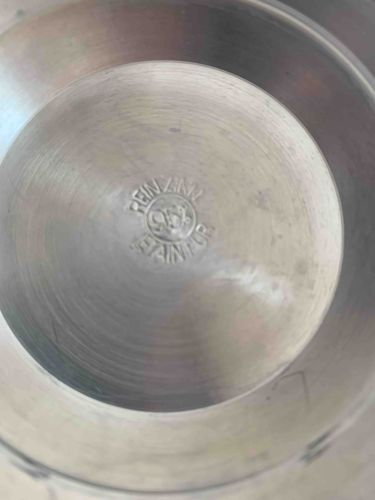
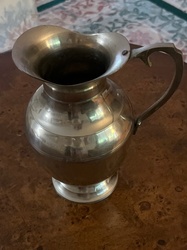
The image displays the interior base of what is identified as a pewter pitcher, specifically focusing on the manufacturer's mark. The material is metal, exhibiting the characteristic dull silver-grey tone of aged pewter with a slightly matte finish. The surface shows concentric light scratches and scuff marks consistent with regular use and cleaning over time, indicating a visible patina rather than a highly polished surface. There are no obvious signs of significant damage such as dents or cracks, though some minor discolouration or oxidation spots may be present, contributing to the aged appearance.
The central distinguishing element is a circular impressed maker's mark. Inside the circle, there is what appears to be a smaller, round emblem or crest, which is somewhat indistinct but seems to contain a stylized motif or initials. Around this central motif, the word "REIN ZINN" is clearly visible, arced above, and "ZINN" below. "REIN ZINN" translates from German to "pure pewter" or "fine pewter," which is a common quality mark indicating a high-grade pewter alloy, typically free of lead in modern manufacturing standards, or at least with very low lead content in older pieces. The legibility of the mark suggests good craftsmanship and a deliberate inclusion by the manufacturer. The style of the typeface and the overall design of the mark suggest it could be from the mid-20th century or earlier, though precise dating without further context is challenging. The visible condition suggests it has been well-preserved for its age, with the wear being primarily superficial patina rather than deep damage. The simplicity and clarity of the mark point to a reputable manufacturer of pewter items.
AI Appraisal Report
Upon examining the provided image of the Pewter Pitcher's interior base, I note the characteristic matte grey of aged pewter, consistent with its description. The visible concentric scratches and scuff marks suggest typical wear from use and cleaning over time, forming a desirable patina rather than severe damage. The absence of obvious dents or cracks indicates good preservation. The crucial element is the clear 'REIN ZINN' maker's mark within a circular impression. This inscription, signifying 'pure pewter' in German, is a key quality indicator, often associated with higher-grade content. The legibility implies a reputable manufacturer and deliberate marking.
Based on visual assessment alone, authenticity appears high for a pewter item of this nature, given the clear and consistent marking. However, a definitive authentication would ideally require physical examination to assess the weight, tactile feel, and precise alloy composition through scientific testing if historical dating to a specific period (e.g., pre-WWII German pewter) were critical. Provenance, such as original purchase records or family history, would also strengthen authenticity claims.
Market conditions for 'REIN ZINN' pewter remain relatively stable, with consistent demand among collectors of antique and vintage European decorative arts. Comparables include similar pitchers by known German pewter manufacturers like Kayserzinn or BMF, though without a specific manufacturer's emblem beyond 'REIN ZINN', it doesn't command the same premium as highly collectible designer pieces. The 'REIN ZINN' mark generally suggests a quality piece, but it is a broader quality indication rather than a specific highly sought-after artist or workshop signature. Rarity is moderate; while not mass-produced, a significant number of 'REIN ZINN' items exist.
The main factors impacting value are its good condition (despite superficial wear), the clear 'REIN ZINN' mark indicating quality, and its functional form as a pitcher which maintains broader appeal. The lack of deeply intricate design or famous maker's name limits its top-tier value. If a specific, rare German pewter maker's emblem were discernible within the circular mark, the value could increase. Currently, it represents a solid example of quality vintage pewter.