These notes were written by the person who submitted this item. Appraiser.AI has not verified them, and the AI's identification and estimate may rely on them.
AI Estimated Value
Not an official valuation
$10 - $20 (per plate)
AI estimate as of November 24, 2025 · verify with a professional before acting
AI-Generated · Verify before acting
Everything on this page is generated by AI for informational purposes only. AI can make mistakes — the AI may misidentify items or misattribute them (artist, maker, brand, designer, origin, era). This is not an official valuation and should not be used for insurance, sale, tax, estate, legal, or lending purposes — or any decision requiring a certified appraisal. It is not an authoritative claim about any person, brand, or rights holder — do not share or rely on it as a factual statement about a third party. Always consult qualified professionals before making financial decisions.
This analysis also relies on unverified notes provided by the user, which may be incomplete or inaccurate and could affect the result.
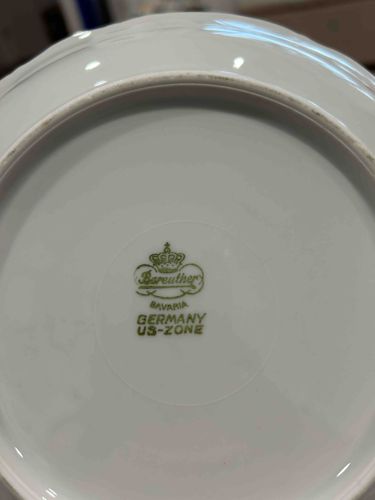
This item is the underside of a white porcelain plate, likely part of a dinnerware set. The material is fine white porcelain, and based on the visible parts of the back, it appears to be a well-crafted piece. The primary distinguishing feature is the green manufacturer's mark located centrally on the base. This mark features a crown design above the word "Bareuther" in a script font, followed by "BAVARIA" in a smaller serif font, and then prominently "GERMANY" and "US-ZONE" stacked below it in a larger, sans-serif font. The phrase "US-ZONE" is particularly significant, indicating that this porcelain was manufactured in the American occupation zone of post-World War II Germany, dating its production between 1945 and 1949. The rim on the underside of the plate shows some minor discoloration or possible residue, appearing as faint brown/grey specks, which could be shelf wear, minor grime, or residue from use. The overall condition of the visible portion of the plate appears to be good for its age, without any obvious chips, cracks, or significant repairs. The craftsmanship suggests a standard quality associated with German porcelain manufacturers of that era. Given the context of "145 years old" provided, there seems to be a discrepancy with the "US-ZONE" marking, which clearly places its age around 75-80 years. The '145 years old' information contradicts the visual evidence of the mark.
AI Appraisal Report
I have examined the image provided, which shows the underside of a Bareuther Bavaria porcelain plate. Based on the clear manufacturer's mark, specifically the 'US-ZONE' designation, I can confidently date this piece to the period between 1945 and 1949. This mark is a direct indicator of its post-World War II German origin, manufactured in the American occupation zone. Therefore, the owner's statement of the item being '145 years old' is incorrect; the plate is approximately 75-80 years old.
The visible portion suggests fine white porcelain, consistent with quality German production of the era. The minor discoloration or residue on the rim appears to be consistent with shelf wear or general use, not significant damage. Without seeing the front or the entire plate, I cannot fully assess its decorative aesthetic or verify the absence of chips, cracks, or repairs on the display surface. However, based on the back, the condition seems reasonable for its age.
In terms of market conditions, Bareuther Bavaria 'US-ZONE' dinnerware is not exceedingly rare. While it tells an interesting historical story, it is generally considered collectible but not high-value antique porcelain. Complete sets command better prices, but individual plates, especially plain ones, typically have modest values. Current comparables in online marketplaces show single dinner plates from this period ranging from $5 to $30, depending heavily on the specific pattern, condition of the front, and overall desirability.
The demand for this specific type of historical dinnerware is niche. Factors impacting value are primarily condition, the specific pattern (if any) on the front, and whether it's part of a larger, intact set. Authenticity of the mark is confirmed visually, but an in-person examination would be necessary to fully assess the plate's overall condition, particularly the front, and rule out any invisible chips, hairline cracks, or previous repairs that would significantly diminish its value. Without this, the appraisal remains limited to the information visible in the provided image.