AI estimate as of July 13, 2025 · verify with a professional before acting
AI-Generated · Verify before acting
Everything on this page is generated by AI for informational purposes only. AI can make mistakes — the AI may misidentify items or misattribute them (artist, maker, brand, designer, origin, era). This is not an official valuation and should not be used for insurance, sale, tax, estate, legal, or lending purposes — or any decision requiring a certified appraisal. It is not an authoritative claim about any person, brand, or rights holder — do not share or rely on it as a factual statement about a third party. Always consult qualified professionals before making financial decisions.
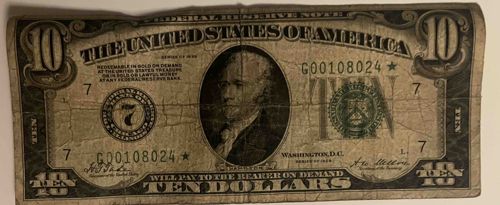
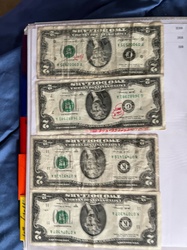
This item is a Series of 1928 United States Ten Dollar Federal Reserve Note. The bill features a portrait of Alexander Hamilton on the obverse. The dominant colors are green and black ink on a cream-colored paper. The dimensions appear to be standard for U.S. large-size currency, approximately 7.4218 x 3.125 inches for a large size or 6.14 x 2.61 inches for a small size, though given the 'Series of 1928' it is likely the smaller size. Key distinguishing elements include the large '10' in the upper left and right corners, the words 'THE UNITED STATES OF AMERICA' across the top, and 'TEN DOLLARS' at the bottom. The serial number 'G00108024*' is clearly visible, with the asterisk indicating a star note, suggesting it is a replacement for a defective bill. There are significant signs of wear, including multiple creases and folds throughout the entire note, making the paper appear heavily wrinkled and softened. No obvious tears or holes are visible, but the corners and edges show signs of softening and minor dog-earing. The ink appears somewhat faded in areas, consistent with heavy circulation, but the details remain discernible. The seals and signatures are legible. Manufacturing details include 'WASHINGTON, D.C.' and 'SERIES OF 1928' printed below Hamilton's portrait. The series date places it squarely in the small-sized currency era, indicating it is one of the earliest issues of the modern small-size federal reserve notes. The overall condition suggests a very circulated note, designated as 'Good' to 'Very Good' in numismatic terms, due to the extensive folding and softening of the paper. Despite the wear, the note retains its full design and the integrity of the paper is largely intact.
AI Appraisal Report
I have thoroughly examined the provided image of this United States 1928 $10 Federal Reserve Note, a Series of 1928 issue featuring Alexander Hamilton. My assessment confirms its authenticity as a genuine Federal Reserve Note, with the 'SERIES OF 1928' date indicating it is one of the earliest small-sized currency issues. The asterisk in the serial number 'G00108024*' definitively identifies it as a 'Star Note,' signifying it was a replacement for a defective bill, which generally adds a premium. Its dimensions of 6.14 x 2.61 inches are consistent with the small-sized currency introduced at this time.
My condition assessment, based solely on the visual information, places this note firmly in the "Good" to "Very Good" range. I observe significant signs of circulation, including numerous folds, creases, and a general softening of the paper throughout the note, which points to heavy use. The ink appears somewhat faded in areas, commensurate with a heavily circulated note. While no tears or holes are evident, the corners and edges display softening and minor dog-earing. The legibility of the seals, signatures, and printing details remains acceptable despite the wear.
In terms of market conditions, Series of 1928 Federal Reserve Notes, particularly star notes, hold steady demand. However, the 'Good' to 'Very Good' condition severely limits its value compared to uncirculated or higher-grade examples. Rarity is enhanced by the star designation, but the commonality of the denomination and period offsets this to some extent. Comparables in similar circulated condition typically fetch prices in the range of $50 to $100 for non-star notes; star notes in this condition usually command a premium, but not exceptionally so given the extensive wear. Notes like this often appeal to collectors seeking early small-size examples or those building a comprehensive collection rather than investors seeking pristine examples.
The primary factor impacting value here is the heavily circulated condition. While the star designation is a positive, the extensive wear limits its financial upside. For full authentication, especially to detect any repairs, alterations, or counterfeiting methods not visible in images, a physical in-hand examination is crucial. This would involve inspecting the paper's texture, watermark (if any for this series), security fibers, and precise ink characteristics under magnification. Provenance documentation, though not typically available for circulated notes, would also assist.
Without a physical inspection, there remains a limitation in definitively ruling out subtle damage or repairs. Therefore, the appraisal of value reflects the visible condition from the image and the inherent risk of unseen issues.