These notes were written by the person who submitted this item. Appraiser.AI has not verified them, and the AI's identification and estimate may rely on them.
AI Estimated Value
Not an official valuation
$40-70
AI estimate as of July 14, 2025 · verify with a professional before acting
AI-Generated · Verify before acting
Everything on this page is generated by AI for informational purposes only. AI can make mistakes — the AI may misidentify items or misattribute them (artist, maker, brand, designer, origin, era). This is not an official valuation and should not be used for insurance, sale, tax, estate, legal, or lending purposes — or any decision requiring a certified appraisal. It is not an authoritative claim about any person, brand, or rights holder — do not share or rely on it as a factual statement about a third party. Always consult qualified professionals before making financial decisions.
This analysis also relies on unverified notes provided by the user, which may be incomplete or inaccurate and could affect the result.
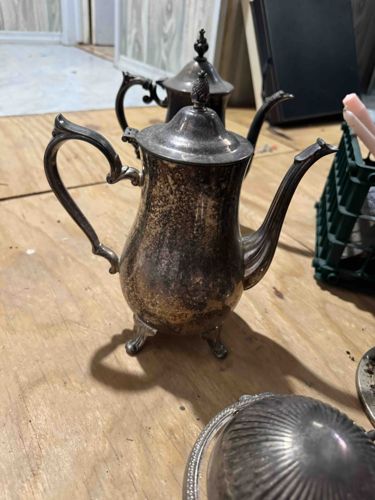
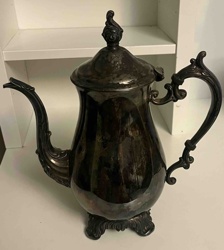
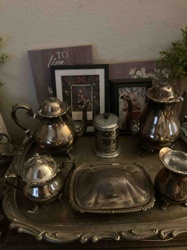
The item is an antique or vintage silver-plated coffee pot, likely part of a larger tea or coffee set. It exhibits a classic, possibly Victorian or early 20th-century design, characterized by an elegant, elongated body and a gracefully curved spout and handle. The handle features a distinct C-scroll shape with an ornate top curl, suggesting a formal aesthetic. The lid is crowned with a finial, which appears to be in the shape of a pinecone or similar decorative element, adding to its intricate detailing. The pot stands on three ornate, possibly cabriole-style feet, providing stability and contributing to its decorative appeal. The silver plating shows significant signs of age and wear, evidenced by pronounced areas of tarnishing, particularly on the main body of the pot, giving it a mottled, dark grey to black patina. Some lighter, shinier areas may indicate points of previous polishing or areas where the plating has worn more smoothly. No prominent maker's marks or signatures are visible in the provided image; however, such marks would typically be found on the base. The overall craftsmanship suggests a mass-produced item from a historical silver plating company, designed to emulate the look of solid silver at a more accessible price point. Despite the heavy patina, the structural integrity seems largely intact, with no obvious major dents or repairs, though a detailed inspection would be needed to confirm this. The dark tarnished state indicates it has not been regularly polished in a long time, suggesting it may have been stored for an extended period.
AI Appraisal Report
Upon examining the provided image of this silver-plated coffee pot, I observe a classic, likely late Victorian or early 20th-century design. The elegant form, C-scroll handle, ornate finial, and cabriole-style feet are characteristic of the period's formal serving ware. The primary factor impacting its current visual appeal and value is its heavily tarnished condition. The significant tarnish suggests long-term storage without polishing, masking the underlying plating's true condition. While the structure appears intact without major dents or repairs, a thorough in-person inspection would be crucial to confirm this and assess for any subtle damage or plating loss. There are no visible maker's marks in the image, which is common for silver-plated items where marks are usually on the base. Without knowing the manufacturer, precise dating and authenticity, beyond general period styling, are challenging.
From a market perspective, silver-plated coffee pots of this era are relatively common. Their value is largely driven by condition, aesthetic appeal, and maker's reputation if known. While elegant, the lack of known provenance or a prominent maker, combined with the tarnished state, places it in the general decorative category rather than a high-value collectible. Demand for such items is consistent but not high, primarily from collectors of antique silver-plate or individuals seeking period decorative accents. Comparables typically sell in the modest range unless they are from a highly sought-after manufacturer or in pristine condition. Factors that would enhance value significantly would include identification of a reputable maker (e.g., Gorham, International Silver Co. in excellent condition), historical provenance, or if it were part of a complete, well-preserved set.
Limitations in authenticity verification from images alone are significant. I cannot definitively ascertain the material composition (e.g., base metal), the extent of plating wear, or detect hairline cracks, subtle repairs, or manufacturer's marks. An in-person examination would allow me to physically inspect the base for marks, assess the true condition of the plating beneath the tarnish, confirm structural integrity, and evaluate the weight and balance, offering a much more precise appraisal.