AI estimate as of July 13, 2025 · verify with a professional before acting
AI-Generated · Verify before acting
Everything on this page is generated by AI for informational purposes only. AI can make mistakes — the AI may misidentify items or misattribute them (artist, maker, brand, designer, origin, era). This is not an official valuation and should not be used for insurance, sale, tax, estate, legal, or lending purposes — or any decision requiring a certified appraisal. It is not an authoritative claim about any person, brand, or rights holder — do not share or rely on it as a factual statement about a third party. Always consult qualified professionals before making financial decisions.
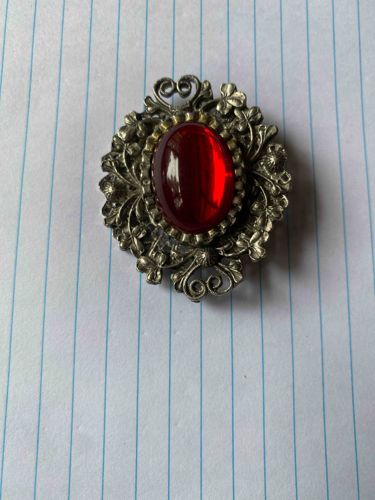
This appears to be a vintage-style brooch or pin featuring a prominent central cabochon stone in a vibrant translucent red hue, possibly glass or a synthetic gemstone. The stone is oval-shaped and set within a decorative bezel that shows some raised dots or 'pearl'-like detailing around its edge. The metalwork surrounding the central stone is intricate and ornate, crafted in a silver-toned metal, which could be pewter, white metal, or silver-plated brass, exhibiting a patinated or oxidized finish that enhances the relief of the design elements. The filigree-like design primarily consists of scrolling foliate motifs, resembling leaves and small clusters of berries or flowers, with some heart-shaped or scrollwork elements at the top and bottom edges, suggesting a romantic or Victorian revival aesthetic. The overall shape of the piece is an irregular oval or escutcheon. The craftsmanship appears to be cast, given the uniform raised patterns, and the details are reasonably well-defined. There are no visible maker's marks or signatures from the image. The condition shows a visible patina consistent with age, and minor surface wear is likely present on the metal, adding to its vintage character. The red stone appears to be in good condition without significant chips or cracks observable. The quality indicates a mass-produced item from the mid-20th century, possibly 1950s-1970s, based on its style and common manufacturing techniques of that era. Its size appears appropriate for a brooch, likely two to three inches in its longest dimension.
AI Appraisal Report
I have examined the image provided for this Vintage Red Cabochon Ornate Brooch. Based on my visual assessment, the brooch features a prominent oval red cabochon, likely glass or synthetic, set in ornate silver-toned metalwork. The design, characterized by scrolling foliate and heart-shaped motifs with a 'pearl'-like bezel, points towards a mid-20th-century mass-produced item, possibly from the 1950s-1970s, reflecting a Victorian revival aesthetic. The metal appears to be pewter, white metal, or silver-plated brass, with an intentional patinated finish that enhances the intricate casting. Authenticity, in terms of its vintage claim, seems plausible based on the style and apparent manufacturing techniques common to that period. The condition appears good for its age, showing consistent patina and minor surface wear, which adds to its vintage appeal. The red stone seems intact without major chips.
Market conditions for such vintage costume jewelry are steady, with demand driven by collectors and enthusiasts of unique, period-specific pieces. Comparable items of this style and material generally retail modestly. This specific brooch, while attractive, is not rare. Factors significantly impacting its value include its costume nature (not precious metals or gemstones), mass production, and lack of a recognized maker's mark. The primary appeal lies in its decorative quality and vintage charm, rather than intrinsic material value.
It is crucial to note the limitations of authenticity verification via images alone. Without physical examination, I cannot definitively confirm the material composition of the stone or metal. An in-person inspection would allow for tactile assessment, detailed examination of construction, and potential identification of faint maker's marks. Provenance documentation could also enhance value and verify origin. Scientific testing, such as spectroscopy for material analysis, would be required for full authentication of components.