AI estimate as of August 11, 2025 · verify with a professional before acting
AI-Generated · Verify before acting
Everything on this page is generated by AI for informational purposes only. AI can make mistakes — the AI may misidentify items or misattribute them (artist, maker, brand, designer, origin, era). This is not an official valuation and should not be used for insurance, sale, tax, estate, legal, or lending purposes — or any decision requiring a certified appraisal. It is not an authoritative claim about any person, brand, or rights holder — do not share or rely on it as a factual statement about a third party. Always consult qualified professionals before making financial decisions.
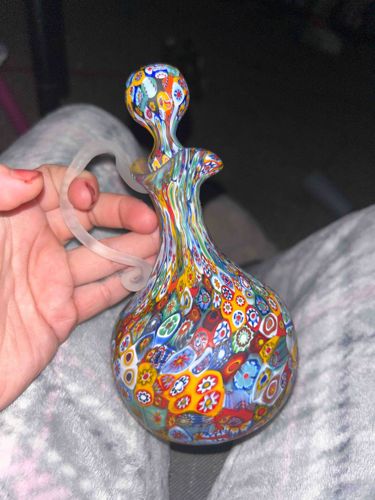
This appears to be a Murano Millefiori glass decanter or small bottle, characterized by its vibrant and intricate design. The piece is constructed from clear glass embedded with numerous colorful millefiori (a thousand flowers) cane slices. The primary colors visible in the canes include various shades of blue, red, green, yellow, orange, and white, forming floral or geometric patterns. The main body of the decanter is bulbous at the base, tapering upwards into a narrower, flaring neck. A clear, possibly frosted or acid-etched glass handle is attached to one side, curving gracefully. The stopper is distinctively shaped, resembling an inverted tear-drop or a stylized finial, and is also adorned with the same millefiori technique, which suggests it is an original part of the vessel and not a replacement. The craftsmanship appears to be of high quality, exhibiting the skillful arrangement of the patterned canes to create a mosaic-like effect across the entire surface. There are no visible signs of significant damage like chips, cracks, or repairs from the provided image; the glass maintains its transparency and luster. The handle's transparency and slightly matte appearance might suggest it is a separate application or a different type of glass, perhaps even acrylic, but given the overall quality, it is likely frosted glass. This style of glasswork is traditionally associated with Murano, Italy, and pieces like this typically date from the mid-20th century onwards. The overall impression is one of meticulous artistry and decorative appeal.
AI Appraisal Report
Upon visual examination of the provided image, this Murano Millefiori glass decanter presents in excellent cosmetic condition. The vibrant colors and intricate arrangement of the millefiori canes are well-preserved, showing no apparent chips, cracks, or significant abrasions on the main body or stopper. The integrity of the glass appears intact, maintaining its luster and transparency. The stopper's matching millefiori design strongly suggests it is original to the piece, enhancing its authenticity and completeness. While the handle's slightly frosted appearance could indicate a different material or finish, without tactile examination, I assume it is frosted glass, consistent with quality craftsmanship. Authenticity, based solely on imagery, points strongly towards Murano origin due to the characteristic millefiori technique and design aesthetics. However, definitive Murano authentication ideally requires physical inspection for specific glass characteristics, pontil marks, or the presence of a signature or label, which are not discernible from the image. Market conditions for genuine Murano millefiori pieces are generally stable, with a consistent demand among collectors of art glass. Pieces of this quality and completeness, especially decanters which are less common than bowls or paperweights, tend to command higher prices. Demand is moderate to strong for well-preserved examples. Rarity is moderate; while millefiori items are not exceedingly rare, a decanter of this specific form and condition is less frequently encountered. Key factors impacting value include the exceptional visual condition, the intricate and well-executed millefiori patterns, and the originality of the matching stopper. The complete absence of visible damage significantly boosts its appeal. For full authentication and to ascertain the exact material of the handle, an in-person examination would be necessary to check for artisan marks, internal glass characteristics, and to perform precise material testing if needed. Provenance documentation, if available, would further solidify its value and history.