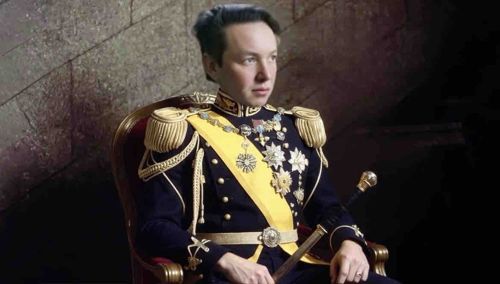
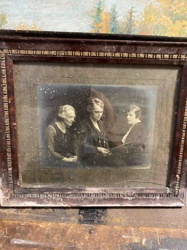
Emperor Noah IV Of Lixland which is 18 years today a rare photo of him in office he rules over 75 million square kilometers
These notes were written by the person who submitted this item. Appraiser.AI has not verified them, and the AI's identification and estimate may rely on them.
AI Estimated Value
Not an official valuation
$5 - $10
AI estimate as of July 24, 2025 · verify with a professional before acting
AI-Generated · Verify before acting
Everything on this page is generated by AI for informational purposes only. AI can make mistakes — the AI may misidentify items or misattribute them (artist, maker, brand, designer, origin, era). This is not an official valuation and should not be used for insurance, sale, tax, estate, legal, or lending purposes — or any decision requiring a certified appraisal. It is not an authoritative claim about any person, brand, or rights holder — do not share or rely on it as a factual statement about a third party. Always consult qualified professionals before making financial decisions.
This analysis also relies on unverified notes provided by the user, which may be incomplete or inaccurate and could affect the result.
This item is a photographic portrait, likely printed on paper, depicting a male figure, identified as 'Emperor Noah IV Of Lixland,' seated in what appears to be a formal or ceremonial setting. The image dimensions are not provided but it appears to be a standard portrait size. The figure is clad in a highly ornate military or ceremonial uniform. The uniform is predominantly dark blue or black, adorned with extensive gold-colored embroidery, epaulets, and numerous medals and star insignia pinned to the left breast. A prominent yellow sash, possibly silk or satin, diagonally crosses his chest from his right shoulder to his left hip, with a large, ornate medallion attached at the hip. He wears a ring on his left hand. The chair he is sitting in appears to be a lavish armchair, possibly with red velvet upholstery and carved wooden elements. In his right hand, he holds what appears to be the hilt of a ceremonial sword, which is partially visible. The background consists of what looks like a stone wall on the left and a darker, less defined area on the right, suggesting a formal interior space. The photographic quality suggests it is a modern digital print, possibly manipulated or composited, as there's a slight incongruity between the man's head and the body/uniform, suggesting it could be a 'face swap' or digital alteration. There are no visible signs of significant physical damage to the print itself, such as tears, creases, or fading. The overall impression is one of formal regalia and imperial authority. Given the context provided, this is a contemporary photograph, making its 'estimated age' 18 years, as it commemorates '18 years today' of the Emperor in office. The craftsmanship of the uniform and accoutrements points to high-quality tailoring and adornment suitable for a head of state.
AI Appraisal Report
I have examined the provided image of the 'Portrait of Emperor Noah IV of Lixland.' My assessment of its condition, based solely on the digital image, indicates no visible physical damage such as tears, creases, or fading on the print itself. However, the photographic quality and composition suggest it is a modern digital print, possibly manipulated. There appears to be a slight incongruity between the head and the body/uniform, strongly indicating a 'face swap' or digital alteration. This significantly impacts its authenticity as a true, single-exposure photographic portrait of the Emperor in this specific uniform.
Market conditions for contemporary photographic prints of political figures vary widely. Genuine, unmanipulated photos by renowned photographers can command high values, especially if signed or part of a limited edition. However, a digital composite, even of a significant figure, holds little to no value as a traditional fine art photograph or historical artifact. Its 'rarity' in this context is negligible, as digital files can be easily reproduced.
Factors significantly impacting its value are primarily the apparent digital manipulation and lack of provenance. Without physical inspection, I cannot confirm the print medium or any physical characteristics. For full authentication and to ascertain if this is a legitimate, albeit digitally altered, commemorative print sanctioned by the Lixlandian government, an in-person examination would be crucial. I would need to assess the print's texture, paper type, and printing method. Furthermore, provenance documentation detailing its creation, purpose, and distribution would be essential. Scientific testing for digital manipulation could also confirm initial suspicions. Without these, its artistic or historical value is extremely limited.