AI estimate as of August 30, 2025 · verify with a professional before acting
AI-Generated · Verify before acting
Everything on this page is generated by AI for informational purposes only. AI can make mistakes — the AI may misidentify items or misattribute them (artist, maker, brand, designer, origin, era). This is not an official valuation and should not be used for insurance, sale, tax, estate, legal, or lending purposes — or any decision requiring a certified appraisal. It is not an authoritative claim about any person, brand, or rights holder — do not share or rely on it as a factual statement about a third party. Always consult qualified professionals before making financial decisions.
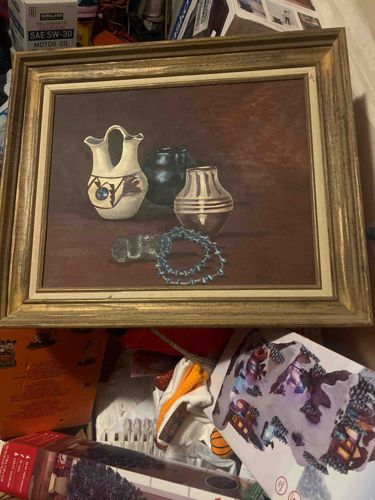
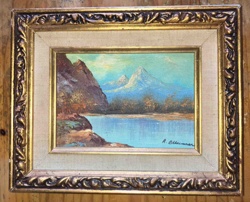
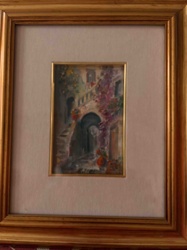
This item is an oil painting or acrylic painting on canvas, depicting a still life composition featuring three Native American-style pottery vessels and a turquoise bead necklace. The overall color palette is warm, dominated by shades of brown and red for the background and surface on which the items rest. The painting is housed within a gilded wooden frame that appears to be in good condition, although specific details like joinery or material quality are not clearly discernible from the image. The foreground features a light-colored, possibly white or cream-colored, pottery piece with a distinctive flared rim and traditional geometric patterns rendered in darker Earth tones, possibly brown or black, with a notable circular blue embellishment or stone setting near its base. To its right, a dark, possibly black or very dark grey, spherical or bulbous pot is present. Further right and slightly forward is another light-colored pottery piece, striped vertically with darker bands. In front of these vessels, a turquoise-colored beaded necklace is prominently displayed, with some of its beads appearing cylindrical and others possibly more irregular, suggesting a handcrafted nature. A glassy or crystalline object, possibly a geode or a polished stone, is also visible beneath the necklace. The artist's hand is visible in the brushstrokes, which suggest a somewhat realistic yet painterly style. No clear artist's signature or specific manufacturing marks are visible in the provided image. The painting appears to be in good visual condition, with no overt signs of damage, fading, or significant patina on the canvas itself, though the lighting and resolution limit a detailed assessment. The frame shows some minor wear consistent with age, but no major chips or cracks are apparent. Based on the subject matter and style, the painting likely dates from the mid-to-late 20th century, possibly reflecting a regional American Southwest aesthetic. The craftsmanship of the painting appears competent, indicating a level of skill in composition and rendering of textures.
AI Appraisal Report
Based on my visual examination of the provided image, this oil or acrylic painting, "Still Life with Native American Pottery and Turquoise Necklace," appears to be in good condition. The canvas shows no overt signs of damage, fading, or significant patina. The gilded wooden frame exhibits minor wear consistent with age but no major deficiencies. Authenticity based solely on imagery is limited; I cannot verify the medium definitively without physical inspection, nor can I find an artist's signature.
The aesthetic suggests a mid-to-late 20th-century origin, likely influenced by Southwestern American art. The skillful composition and rendering of textures indicate a competent artist. Market conditions for decorative still life paintings of this era and style are modest. Comparable works by unknown or regional artists typically fetch prices in the lower hundreds, unless there is an established provenance or unique artistic merit. Demand within the general art market for unsigned decorative art remains stable but not highly competitive. Rarity is difficult to ascertain without knowing the artist's body of work, but still life subjects are common.
Factors impacting value include the lack of an identifiable artist, which limits its collectability beyond decorative appeal. The subject matter has regional appeal, which could influence interest in specific markets. For full authentication and a more precise valuation, an in-person examination is crucial to confirm the medium, inspect for an artist's signature or other identifying marks, assess brushstroke quality and paint layer integrity, and analyze frame construction. Provenance documentation (e.g., prior sales records, exhibition history) would significantly aid in establishing authenticity and market value, as would scientific testing if true age or material composition were questioned.