AI estimate as of December 6, 2025 · verify with a professional before acting
AI-Generated · Verify before acting
Everything on this page is generated by AI for informational purposes only. AI can make mistakes — the AI may misidentify items or misattribute them (artist, maker, brand, designer, origin, era). This is not an official valuation and should not be used for insurance, sale, tax, estate, legal, or lending purposes — or any decision requiring a certified appraisal. It is not an authoritative claim about any person, brand, or rights holder — do not share or rely on it as a factual statement about a third party. Always consult qualified professionals before making financial decisions.
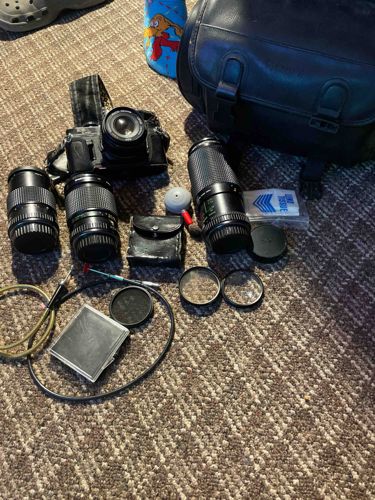
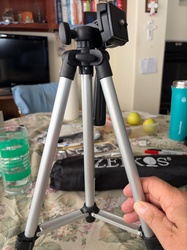
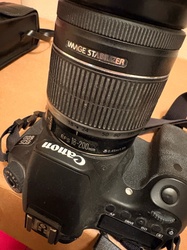
This item is a comprehensive vintage single-lens reflex (SLR) camera kit, likely from the late 20th century, possibly the 1970s or 1980s, given the design and style of the components. The core of the set is an SLR camera body, appearing to be black plastic and/or metal construction, fitted with a lens and featuring a standard camera strap. The camera body itself shows signs of moderate use, with some scuffs or dust visible. Accompanying the camera are at least three interchangeable lenses: one attached to the camera, and two additional lenses. These lenses appear to be telephoto or zoom lenses, characterized by their elongated barrel and rubberized grip rings for focus and zoom. They are predominantly black with some green markings on the rings, indicating focal lengths or aperture settings. The lenses exhibit some dust and minor surface wear. The kit also includes a variety of photographic accessories: a black leatherette camera bag for transport and protection, suggesting a complete carrying solution; several circular lens filters, possibly UV or polarizing filters, some housed in a metal case; a cable release for remote shutter actuation; a small, possibly leather, pouch for smaller accessories; a white spherical item which could be a light meter or a specialized filter; and a lens cleaning kit, evidenced by the small white packet marked 'lens tissue' and a small brush. The overall condition suggests a well-used but functional vintage setup, showing typical wear and tear consistent with its age and intended purpose. The quality indicates a consumer-grade or prosumer-level camera system from its era, offering versatility with its multiple lenses.
AI Appraisal Report
I have examined the provided image of this vintage SLR camera kit with multiple lenses and accessories. Based on my visual assessment, the kit appears to be a consumer-grade or prosumer-level system likely from the 1970s or 1980s. The camera body shows moderate use, with scuffs and dust, consistent with its age and frequent handling. The three lenses, including the one attached to the camera, exhibit similar wear and what appears to be dust, which will require cleaning. The presence of green markings on the lens rings suggests typical kit or third-party lenses of the era. The accessories, such as the camera bag, filters, cable release, and cleaning kit, enhance the completeness of the package. While the overall condition indicates a well-used setup, it also suggests potential functionality.
Market conditions for vintage SLR kits like this are generally moderate. While individual components might fetch low prices, a complete, functional kit with multiple lenses and accessories can appeal to collectors, photography enthusiasts, or those seeking a retro aesthetic. The demand for such kits is niche but consistent. Rarity is not a significant factor here; these types of cameras and lenses were produced in large quantities.
The primary factors impacting value are the camera's make and model (which I cannot discern from the image), the specific aperture and focal range of the lenses, and crucially, their functional condition. The unknown functionality of the camera body (shutter, light meter, film advance) and the lenses (focusing, aperture blades, haze/fungus) is a major detractor to value.
My primary limitation in authenticity and valuation is the reliance solely on images. I cannot verify the specific brand or model of the camera or lenses, which are critical for precise valuation. An in-person examination would be required to assess the full operational status of the camera and lenses, check for internal lens haze or fungus, test the light meter, and inspect the integrity of mechanical movements. Provenance documentation, while not usually available for consumer-grade equipment of this era, would ideally confirm its history, but is not expected here. Without physical inspection, I am unable to confirm functionality, which is paramount for a photographic tool.