AI Appraisal Estimate

AI-generated estimates · not official valuations

From the user

What was submitted

Photo and notes provided by the user — not generated by AI

Submitted item photo
Submitted photo · June 6, 2026

User's notes

Holland porcelain tile

AI analysis below

AI appraisal

AI analysis & estimate

AI-Generated · Verify before acting

Everything below is generated by AI for informational purposes only. AI can make mistakes — the AI may misidentify items or misattribute them (artist, maker, brand, designer, origin, era). This is not an official valuation and should not be used for insurance, sale, tax, estate, legal, or lending purposes — or any decision requiring a certified appraisal. It is not an authoritative claim about any person, brand, or rights holder — do not share or rely on it as a factual statement about a third party. Always consult qualified professionals before making financial decisions.

Note

This analysis also relies on unverified notes provided by the user, which may be incomplete or inaccurate and could affect the result.

Read the full disclaimer

AI Identification

·Not independently authenticated·Verify before acting

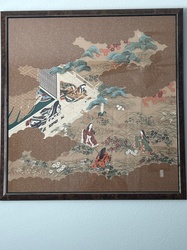
Framed Delft-Style Holland Porcelain Tile with Workshop Scene

Decorative Arts

AI Estimated Value

·Not an official valuation·Verify before acting

$40-75

As of June 6, 2026

AI Item Analysis

·AI can make mistakes·Verify before acting
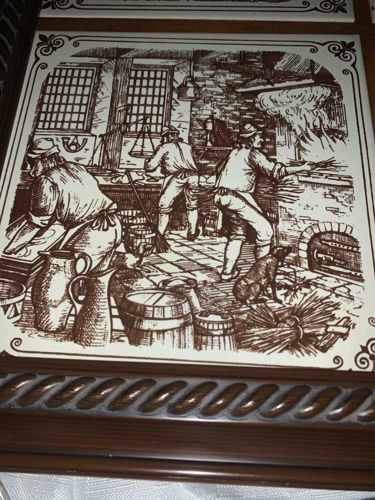
This item is a decorative ceramic tile, likely a Holland porcelain tile, set within a carved wooden frame. The tile itself features a sepia-toned, illustrative scene depicting a bustling interior, possibly a workshop or bakery. The primary color of the illustration is a rich brown, contrasting with the off-white or cream base of the tile. In the foreground, several figures, presumably men, are engaged in various tasks. One figure on the left appears to be working at a table with pitchers and barrels nearby. In the center, another figure is sweeping, while to the right, a third figure is tending to a large oven or forge from which flames and smoke emanate prominently. A dog is also visible near the oven. The background includes windows with grid patterns, suggesting an indoor setting. The artistic style is reminiscent of etchings or woodcuts, characterized by fine lines and cross-hatching to create depth and texture. The tile is bordered by a decorative scrollwork design in the same brown hue at each corner. The tile appears to be in good condition with no obvious chips or cracks visible from the provided image, retaining its clear imagery and color. It exhibits a classic, slightly rustic aesthetic, hinting at a 20th-century European folk art or historical revival style. The tile is mounted in a dark brown, possibly mahogany or stained wood, frame. The frame features a distinctive rope or twisted pattern along its inner edge, adding to its decorative appeal and indicating a degree of craftsmanship. The overall presentation suggests it is intended as a wall hanging or a part of a larger decorative panel. The quality of the illustration is detailed, suggesting good craftsmanship in the tile's production.
AI Appraisal Report

·AI can make mistakes·Verify before acting
Upon examining the images of this framed Holland porcelain tile, I find it to be a charming decorative piece, likely produced in the 20th century in the style of historical Delftware. The tile depicts a detailed workshop scene in a sepia monochrome palette, a common modern variation on the traditional blue and white. The artwork is well-executed, with fine lines reminiscent of an etching. The porcelain appears to be in excellent condition, with no visible chips, cracks, or crazing from the photograph. The carved wooden frame with its rope-twist inner border is of good quality and complements the tile's rustic aesthetic, adding to its decorative appeal. The market for such individual decorative tiles is generally modest. While antique 17th or 18th-century Delft tiles can command high prices, 20th-century revival pieces like this are more accessible. Similar framed, single-scene Dutch or German tiles from the mid-20th century typically sell at auction or in antique shops in the $40 to $80 range, depending on the maker, artistic quality, and frame condition. The detailed and engaging workshop scene is a positive value factor, as it is more desirable than a simple floral or landscape motif. However, this appraisal is limited by the inability to conduct a physical examination. To confirm its age and origin, I would need to inspect the tile out of its frame to look for a maker's mark (e.g., Royal Tichelaar Makkum, Porceleyne Fles) on the reverse. Without such a mark or provenance, it must be appraised as a decorative piece of indeterminate, likely 20th-century, origin.

Get your items appraised

Instant estimates of your treasures with AI-powered appraisals

Browse More Appraisals