These notes were written by the person who submitted this item. Appraiser.AI has not verified them, and the AI's identification and estimate may rely on them.
AI Estimated Value
Not an official valuation
$75-150
AI estimate as of August 28, 2025 · verify with a professional before acting
AI-Generated · Verify before acting
Everything on this page is generated by AI for informational purposes only. AI can make mistakes — the AI may misidentify items or misattribute them (artist, maker, brand, designer, origin, era). This is not an official valuation and should not be used for insurance, sale, tax, estate, legal, or lending purposes — or any decision requiring a certified appraisal. It is not an authoritative claim about any person, brand, or rights holder — do not share or rely on it as a factual statement about a third party. Always consult qualified professionals before making financial decisions.
This analysis also relies on unverified notes provided by the user, which may be incomplete or inaccurate and could affect the result.
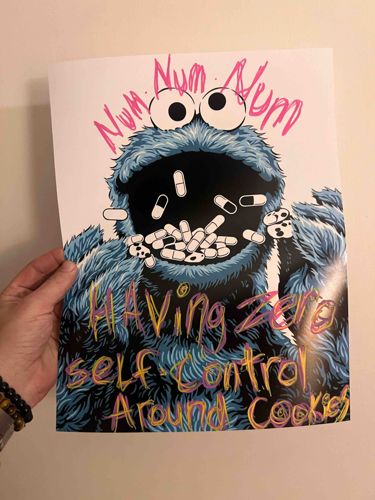
This is a contemporary art print, likely a giclee or screen print, featuring a stylized and somewhat subversive cartoon character resembling the Cookie Monster from Sesame Street. The print depicts a large, furry, blue character with characteristic wide-set, googly eyes. Instead of cookies, the character's mouth is filled with numerous white and black capsules or pills, some of which are spilling out. Above the character's head, in bright pink, scrawled lettering, are the words 'Num Num Num,' mimicking Cookie Monster's signature phrase. Below the character, prominent text in a multi-colored, distressed, or layered font reads 'HAVING ZERO Self Control Around Cookies'. The color palette is vibrant, with shades of blue for the fur, stark white and black for the eyes and pills, and neon pink, yellow, purple, and green for the text. The style appears to be modern, possibly street art-influenced or pop art, with bold outlines and flat color areas. The paper appears to be clean, bright white, and free from significant creases, tears, or discoloration, indicating good to excellent condition. The edges of the print seem sharp, suggesting it's either newly printed or has been well-preserved. There are no visible artist signatures, edition numbers, or maker's marks in the provided image. The overall impression is edgy and satirical, subverting a well-known children's character for a more adult theme related to self-control and consumption. The print's estimated age is contemporary, likely post-2000, given its themes and aesthetic.
AI Appraisal Report
I have examined the provided image of the "Having Zero Self Control Around Cookies" Art Print. Visually, the print appears to be in excellent condition, with clean, bright white paper, sharp edges, and no visible creases, tears, or discoloration. The vibrant colors and bold lines suggest a well-executed giclée or screen print process.
Authenticity, based solely on this image, is limited to visual assessment. The style is consistent with contemporary pop art or street art influences, which often appropriate well-known figures for satirical commentary. However, without a physical examination, I cannot verify the type of print (e.g., giclée vs. screen print), paper quality, or the presence of any blind stamps, watermarks, or subtle print details that might signify a specific artist or publisher. Crucially, the absence of an artist's signature, edition number, or maker's mark in the image prevents definitive attribution or authentication.
Market conditions for satirical, street art-inspired prints vary widely. Comparables would include works by artists who use similar appropriation techniques, often sold in limited editions. The subversion of a popular children's character like Cookie Monster appeals to a niche market interested in edgy, pop culture-infused art. Demand for such pieces can be strong, especially if attributed to a known artist; however, without attribution, the rarity is undeterminable and demand is primarily driven by aesthetic appeal.
Factors significantly impacting value here are primarily the lack of artist identification and edition information. An in-person examination would be needed to assess paper stock, print quality, and search for any hidden marks. Provenance documentation (e.g., purchase receipts, artist's certificates) or, in some cases, scientific testing (e.g., ink analysis) would be essential for full authentication and to establish a higher value. Without such details, it functions more as a decorative print tailored to specific tastes.
Given the excellent condition but unknown artist, edition, and specific print type, the value is primarily decorative.