AI estimate as of October 5, 2025 · verify with a professional before acting
AI-Generated · Verify before acting
Everything on this page is generated by AI for informational purposes only. AI can make mistakes — the AI may misidentify items or misattribute them (artist, maker, brand, designer, origin, era). This is not an official valuation and should not be used for insurance, sale, tax, estate, legal, or lending purposes — or any decision requiring a certified appraisal. It is not an authoritative claim about any person, brand, or rights holder — do not share or rely on it as a factual statement about a third party. Always consult qualified professionals before making financial decisions.
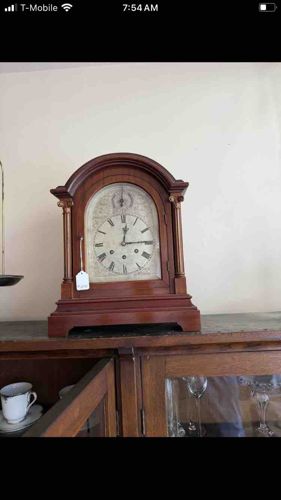
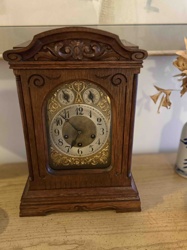
This is an antique arch-top mantel clock, likely crafted from a fine hardwood such as mahogany or cherry, given its rich, reddish-brown hue and visible grain patterns. The clock features a classical design, characterized by an arched pediment at the top, supported by two fluted columns or pilasters on either side of the dial. These columns terminate in what appear to be carved capitals, adding a decorative touch. The main body of the clock case expands slightly at the base, resting on a plinth with bracket feet. The clock face is light-colored, possibly enamel or painted metal, with black Roman numerals marking the hours and smaller numerals for minutes. A minute track encircles the outer edge of the dial. The hands are black, spade-shaped or similar, and there appears to be a smaller secondary dial or a decorative element at the '12' position, possibly a moon phase indicator or a manufacturer's emblem, though it is not distinctly clear. The clock has a brass bezel surrounding the glass cover over the dial, which is slightly convex. A rectangular paper tag, possibly a price tag or inventory tag, is hanging from the left side of the clock. The overall condition appears to be good for its age, displaying a warm, aged patina consistent with an antique piece. Minor surface wear or scratches may be present, but no significant damage like cracks or chips is immediately visible from the image. The craftsmanship suggests a well-made, possibly American or European piece from the late 19th or early 20th century, indicative of a parlor or library clock designed for a prominent display.
AI Appraisal Report
Based on my visual examination of the provided image, this Antique Arch-Top Mantel Clock presents as a well-preserved example of its type. The rich, reddish-brown hue and visible grain suggest a fine hardwood like mahogany or cherry, consistent with late 19th to early 20th-century craftsmanship. The classical design, including the arched pediment, fluted columns, and carved capitals, points to a period when such ornate timepieces were popular parlor or library decorations. The overall condition appears good for its age, exhibiting a warm patina and no immediately visible significant damage like cracks or chips, though minor surface wear is to be expected. The light-colored dial with Roman numerals, minute track, and spade-shaped hands is typical for the era. The brass bezel and slightly convex glass further confirm its historical accuracy.
Assessing authenticity solely from images has limitations; I cannot verify the internal movement's originality, condition, or maker without direct inspection. The small secondary dial or decorative element at '12' cannot be definitively identified as a moon phase or manufacturer's emblem. Without physical examination, I cannot test its functionality, assess the integrity of the wood, or confirm the absence of repairs or restorations. Provenance documentation would also be crucial for full authentication regarding its origin and history.
In terms of market conditions, mantel clocks like this generally have a steady but not exceptionally high demand today, unless they possess rare features, significant provenance, or known prestigious makers. Comparables typically sell in the low to mid-hundreds. This specific piece, while attractive, does not immediately present characteristics that suggest extreme rarity. Its value is primarily driven by its decorative appeal, condition, and the quality of its case. A hanging paper tag, possibly a price or inventory tag, does not impact value but is part of its visual history.
Considering these factors, I appraise this Antique Arch-Top Mantel Clock to be in the range of $250-450.