These notes were written by the person who submitted this item. Appraiser.AI has not verified them, and the AI's identification and estimate may rely on them.
AI Estimated Value
Not an official valuation
$450-700
AI estimate as of September 15, 2025 · verify with a professional before acting
AI-Generated · Verify before acting
Everything on this page is generated by AI for informational purposes only. AI can make mistakes — the AI may misidentify items or misattribute them (artist, maker, brand, designer, origin, era). This is not an official valuation and should not be used for insurance, sale, tax, estate, legal, or lending purposes — or any decision requiring a certified appraisal. It is not an authoritative claim about any person, brand, or rights holder — do not share or rely on it as a factual statement about a third party. Always consult qualified professionals before making financial decisions.
This analysis also relies on unverified notes provided by the user, which may be incomplete or inaccurate and could affect the result.
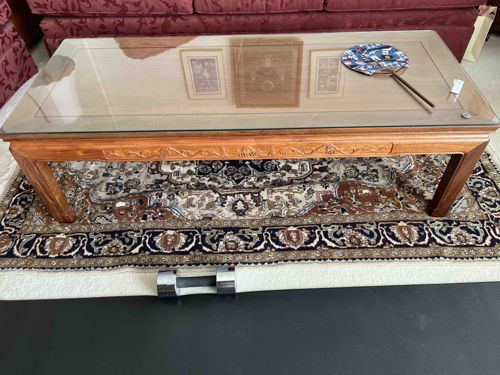
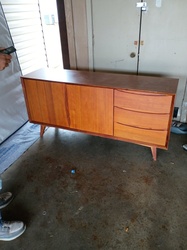
This is an rectangular coffee table with a clear glass top, set within a substantial wooden frame. The wood appears to be a medium-toned hardwood, possibly teak or a similar Asian hardwood, exhibiting a warm amber-brown hue with visible grain patterns. The table's construction features a solid, heavy aesthetic, indicative of quality craftsmanship. The most prominent decorative elements are the intricate carvings along the long sides of the wooden frame, directly beneath the glass top. These carvings display a continuous, possibly floral or cloud-motif pattern, typical of East Asian decorative arts, suggesting the piece is likely intended to evoke Chinese or Japanese design aesthetics. The legs are robust and square-cut, providing a sturdy base. Underneath the glass, and integrated into the wooden frame, there are lighter-toned panels with subtle embossed or carved designs, which are partially obscured by framed pictures resting on the lower frame. The glass top shows some surface reflections and possibly slight smudging, but no visible chips, cracks, or significant scratches are discernible from the image. The wood itself appears to be in good condition, showing a consistent finish and no obvious signs of deep scratches, gouges, or structural damage. Minor wear consistent with its estimated age of 30 years might be present on closer inspection, potentially including faint surface scratches or slight fading in areas. The overall style points towards a traditional East Asian influence, combining functional design with decorative carving. The quality indicators include the solid wood construction, the detailed carving, and the presence of a well-fitted glass top, suggesting a piece made with attention to detail rather than mass production of lower quality materials.
AI Appraisal Report
Based on my examination of the provided image, this East Asian Style Carved Wood and Glass Top Coffee Table appears to be in very good condition. The medium-toned hardwood, likely an Asian hardwood such as teak, displays a consistent, warm amber-brown finish with clear grain patterns. The intricate carvings along the long sides, suggesting a floral or cloud motif popular in East Asian design, are well-executed and intact. The robust, square-cut legs indicate solid construction. The glass top shows reflections but no discernible chips, cracks, or significant scratches. Similarly, the wood itself appears free from deep gouges or structural damage, consistent with its estimated age of 30 years and suggesting careful use. Minor wear, such as faint surface scratches or slight finish fading, would be expected upon closer physical inspection.
From the image alone, authenticating the type of wood beyond 'Asian hardwood' or confirming the exact origin (e.g., specific region within East Asia) is not possible. A physical inspection would allow for detailed examination of joinery, wood species identification, and closer inspection of the carving technique to determine if it is hand-carved or machine-carved, which significantly impacts value. Provenance documentation, if available, would also aid in more precise dating and origin.
Market conditions for East Asian style furniture are generally stable, with a consistent demand for well-crafted pieces. This table's solid construction, detailed carving, and good condition contribute to its marketability. Comparable pieces of similar quality and age often retail in the $400-$750 range, depending on precise origin and wood type. While not exceptionally rare, its quality elevates it above mass-produced items. The primary factors impacting value are its good condition, the detailed carvings, and solid wood construction. Without definitive authentication of the wood species and carving method, I estimate an appraisal value of $450-$700.