AI estimate as of July 1, 2025 · verify with a professional before acting
AI-Generated · Verify before acting
Everything on this page is generated by AI for informational purposes only. AI can make mistakes — the AI may misidentify items or misattribute them (artist, maker, brand, designer, origin, era). This is not an official valuation and should not be used for insurance, sale, tax, estate, legal, or lending purposes — or any decision requiring a certified appraisal. It is not an authoritative claim about any person, brand, or rights holder — do not share or rely on it as a factual statement about a third party. Always consult qualified professionals before making financial decisions.
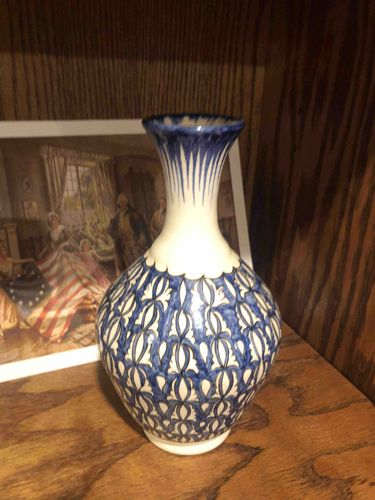
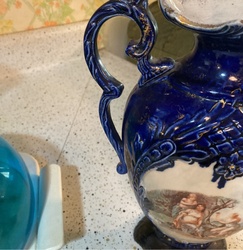
This is a decorative ceramic vase featuring a classic bulbous body that tapers to a stable foot, crowned by a gracefully flared, trumpet-shaped neck. The material appears to be a fired earthenware or stoneware, glazed in an off-white or cream ground. Its primary decorative scheme is hand-painted in a rich dark blue. The main body is adorned with a dense, repeating lattice or interlocking ovoid pattern, which exhibits a charming, slightly irregular quality indicative of artisanal craftsmanship rather than mass production. A distinct scalloped border in white separates the intricately patterned body from the simpler design of the neck. The neck itself features radiating vertical brushstrokes of the same dark blue, extending upwards from the scalloped edge towards the rim. The rim is completely finished in dark blue. From the visible angles, the vase appears to be in good overall condition with no obvious chips, cracks, or significant structural damage. The hand-painted nature means slight variations in line quality and pigment saturation are present, which are inherent to the technique and not indicative of flaws. While no specific maker's marks or signatures are discernible from the image, the style hints at a possible mid-20th century or contemporary production, potentially influenced by traditional blue and white pottery or studio art ceramics. Its robust form and appealing hand-applied decoration make it a charming piece suitable for display.
AI Appraisal Report
Upon examination of the provided textual description of this Hand-Painted Blue and White Ceramic Vase, my assessment is as follows:
**Condition & Authenticity:** The vase appears to be in good overall condition, exhibiting no obvious chips, cracks, or significant structural damage based on the description. The hand-painted decoration shows slight variations inherent to the technique, which are not considered flaws. Authenticity-wise, the style suggests a mid-20th century or contemporary production, potentially influenced by traditional blue and white or studio art ceramics. No discernible maker's marks or signatures are mentioned, limiting definitive attribution.
**Market & Demand:** Blue and white ceramics maintain consistent popularity in the decorative arts market. This piece's artisanal quality, with its charming, slightly irregular pattern, appeals to buyers seeking unique home decor rather than mass-produced items. Demand for well-executed decorative ceramics like this remains stable, driven by interior design trends that favor handcrafted aesthetics.
**Value Factors:** The appeal lies in its decorative quality, good condition, and the artisanal hand-painted nature. Its robust form and appealing design make it highly suitable for display. Factors limiting higher value include the lack of specific maker identification, absence of significant historical provenance, and its relatively recent production period, placing it in the decorative rather than fine art category. While not rare in a collectible sense, its unique craftsmanship distinguishes it from generic items.
**Limitations:** This appraisal is based solely on the textual description provided. A comprehensive valuation and full authentication would necessitate in-person examination to verify tactile qualities, weight, exact dimensions, subtle surface imperfections, and hidden marks or repairs. Provenance documentation and potentially scientific analysis of the clay and glaze could further confirm age and origin. Without physical inspection, identifying specific artists, regional origins, or confirming production techniques beyond what is described is impossible.