AI estimate as of December 10, 2025 · verify with a professional before acting
AI-Generated · Verify before acting
Everything on this page is generated by AI for informational purposes only. AI can make mistakes — the AI may misidentify items or misattribute them (artist, maker, brand, designer, origin, era). This is not an official valuation and should not be used for insurance, sale, tax, estate, legal, or lending purposes — or any decision requiring a certified appraisal. It is not an authoritative claim about any person, brand, or rights holder — do not share or rely on it as a factual statement about a third party. Always consult qualified professionals before making financial decisions.
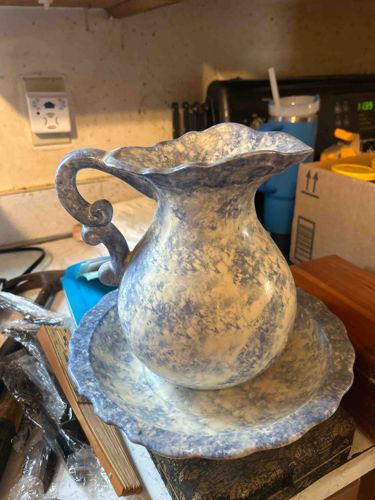
This item is a two-piece ceramic set consisting of a pitcher and a matching basin. The pitcher features a bulbous body, a gracefully curved handle with a scroll-like embellishment near the top attachment point, and a scalloped, flaring rim. The basin is round with a deeply curved interior and a wide, ruffled or scalloped edge that mirrors the pitcher's rim. Both pieces are made of ceramic material finished with a distinctive blue and off-white 'spatterware' or 'sponge ware' glaze. The blue appears to be a muted cornflower or dusty blue, randomly distributed over a creamy or off-white base, creating a mottled, speckled, or splotchy effect. The glaze has a slightly glossy finish. The overall aesthetic suggests a rustic or farmhouse style. There are no immediately visible chips, cracks, or significant damage, though a closer inspection would be needed to confirm the absence of hairline fractures or crazing, common in older ceramic pieces. The craftsmanship appears to be sturdy, with the handle well-integrated into the pitcher's body. The weight and exact dimensions are not discernible from the image, but the set appears to be of a substantial size, likely intended for decorative use or as a traditional wash basin set. No specific maker's marks or signatures are visible. The style generally points to a vintage or antique period, possibly late 19th to mid-20th century, though without hallmarks, this is an estimation.
AI Appraisal Report
Based on my visual examination of the provided image, this Blue and White Spatterware Ceramic Pitcher and Basin Set appears to be a well-preserved example of decorative ceramic ware. The 'spatterware' or 'sponge ware' glaze is characteristic of late 19th to mid-20th century American or European folk art ceramics. The design, including the bulbous pitcher body, scroll-like handle embellishment, and scalloped rims, aligns with a rustic or farmhouse aesthetic that remains popular among collectors of vintage and antique home decor.
From the image, the condition appears to be very good with no immediately visible chips, cracks, or significant damage. The glaze has a pleasing gloss. However, without a physical inspection, it is impossible to confirm the absence of hairline fractures, crazing (fine web-like cracks in the glaze common in older ceramics), or minor repairs that might not be visible in photographs. The lack of visible maker's marks is also a limitation; while many spatterware pieces were unsigned, a known manufacturer could significantly impact value. Authenticity is tentatively accepted based on stylistic cues, but a hands-on review would involve checking for inconsistencies in glaze application, mold lines, and material properties.
Market demand for spatterware, particularly pitcher and basin sets, is steady but not extraordinarily high unless associated with a prominent maker or exceptional rarity. Comparable sets in good condition typically fetch between $100 and $400, depending on size, specific pattern, and provenance. Without provenance documentation or a physical examination to ascertain craftsmanship quality, exact age, and the presence of any hidden flaws, I am estimating a value at the mid-to-lower end of this range. An in-person inspection would allow for tactile assessment of weight, balance, and a thorough search for any damage or repairs, which are critical for a definitive valuation.