AI Appraisal Estimate

AI-generated estimates · not official valuations

From the user

What was submitted

Photo and notes provided by the user — not generated by AI

Submitted item photo
Submitted photo · May 22, 2026

User's notes

No additional notes provided.

AI analysis below

AI appraisal

AI analysis & estimate

AI-Generated · Verify before acting

Everything below is generated by AI for informational purposes only. AI can make mistakes — the AI may misidentify items or misattribute them (artist, maker, brand, designer, origin, era). This is not an official valuation and should not be used for insurance, sale, tax, estate, legal, or lending purposes — or any decision requiring a certified appraisal. It is not an authoritative claim about any person, brand, or rights holder — do not share or rely on it as a factual statement about a third party. Always consult qualified professionals before making financial decisions.

Read the full disclaimer

AI Identification

·Not independently authenticated·Verify before acting

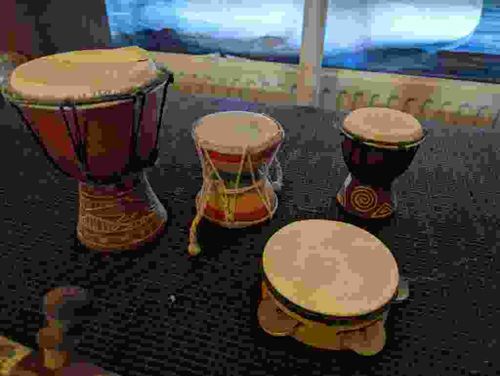
Set of Miniature Hand Drums and Percussion Instruments

Musical Instruments / Percussion / Ethnographic Art

AI Estimated Value

·Not an official valuation·Verify before acting

$45.00 - $65.00

As of May 22, 2026

AI Item Analysis

·AI can make mistakes·Verify before acting
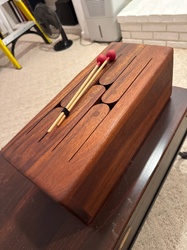
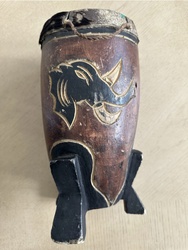
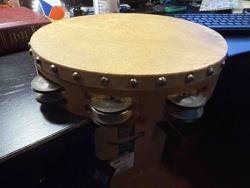
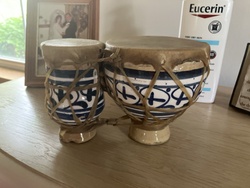
This assembly consists of four distinct miniature percussion instruments, primarily of the hand-drum variety. The largest piece, positioned on the far left, is a goblet-style djembe drum featuring a hand-carved wooden base with geometric etchings and a natural skin-stretched head secured by black rope tensioning. Beside it is a smaller, hourglass-shaped drum, likely a miniature dundun or talking drum, characterized by decorative horizontal stripes in red and orange with a light-colored rope lattice. To the right is a small djembe with a dark-finished body adorned with yellow spiral painted motifs. In the foreground sits a small wooden tambourine with a synthetic or natural skin head and visible metal jingling zills nested in the rim. The items appear to be made from soft wood, natural animal skins, and hemp or synthetic rope. The construction indicates handcrafted folk-art production, common in souvenir or educational music markets from regions such as West Africa or Southeast Asia. Condition appears fair to good; the skin heads show light discoloration consistent with age and handling, and the wood on the tambourine displays minor surface abrasions. The estimated age is late 20th century to contemporary. These are functional musical curiosities rather than professional-grade performance equipment, valued for their decorative and ethnographic appeal.

AI Appraisal Report

·AI can make mistakes·Verify before acting
I have carefully examined the provided images of this four-piece set of miniature percussion instruments. My assessment confirms these pieces are decorative folk-art curiosities, likely produced in the late 20th century to modern era for the global souvenir and gift market. The largest djembe exhibits hand-carved geometric patterns on the foot, while the smaller djembe features painted spiral motifs typical of mass-produced ethnographic crafts. The construction utilizes softwoods, basic organic skins, and synthetic/hemp cordage. The condition is fair to good. I observe minor surface scuffs on the tambourine rim and slight yellowing of the drum heads, which is expected for natural materials of this age. Market demand for these items remains stable but low, as they lack the acoustic resonance and structural integrity required for professional musical use. They are valued primarily as decorative shelf-pieces. Comparable sets typically retail individually between $10 and $20 in secondary markets like online auctions or estate sales. Significant value limitations exist. Without a physical inspection, I cannot confirm the specific wood species or if the skins are authentic animal hide versus a high-grade synthetic. To reach a definitive authentication of origin (e.g., verifying if the larger djembe is specifically West African versus a Southeast Asian reproduction), I would require provenance documentation or tactile inspection of the carving marks and wood grain. For higher valuations in this category, one would need to see evidence of use by a recognized master drummer or unique historical pedigree, neither of which is present in these examples.

Get your items appraised

Instant estimates of your treasures with AI-powered appraisals

Browse More Appraisals